Booing the King
The Purim story blames everyone for the violence within it, and it is ultimately the fault of a despotic ruler

I have been going on about Purim for years. Specifically, about the violence in the story, and how we need to talk about it. Some 13 years ago I wrote an article on the subject (under a pseudonym but I’m happy to take ownership of it), which Peter Beinart has recommended and I think influenced the discussion of the issue in his recent Being Jewish After the Destruction of Gaza (a credit in the next edition wouldn’t hurt, Peter).
I haven’t changed my mind. But I have gained a new perspective which I think is helpful. I used to be focused on the story being fictional. I still think it is, there’s no way that it really happened. But now I am more aware of authorial intent. In short, I think the critique I made then of the Jewish characters’ behaviour is there in the original text of Esther; I think the authors intended us to notice it. And I think we need to pay a great deal more attention to King Ahasuerus - since it is under the umbrella of his power that all the terrible events in the story occur.
The first thing to note is the period in which the story is set. Ahasuerus is generally identified with Xerxes 1, who reigned from 486-465BCE; some Jewish sources identify him with Xerxes’ son Artaxerxes who succeeded his father, ruling from 465-424. Either way, this dates the story to after King Cyrus’ proclamation of 539 which allowed Jews to return to Jerusalem and rebuild the Temple, which was completed around 515. So the story is set (and likely written) in the period when Jews could return to Jerusalem, but some were choosing not to and remaining in Persia. The story is then a polemic against such non-returnees, composed by those who returned to Judea. Its message is that those who do not return will be fatally compromised by imperial power and their proximity to it. With this framework we can understand that the story is a depiction of a dystopian evil empire; all the characters behave abominably within it because they are shaped by its immorality.
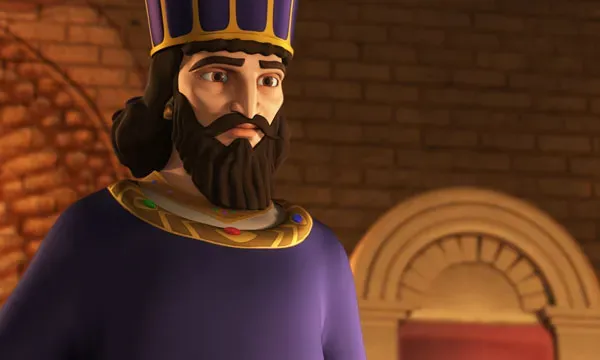
And that immorality is established right from the start, centred around the figure of the King. The first thing we learn about him is the vastness of his empire – from India to North Africa (which to the writers of the Megillah is essentially the entire world). The second is his love for showing off – he displays the riches of his kingdom for 180 days – like an early imperial exhibition – riches which he has no doubt stolen from all the peoples he has conquered. He holds a week-long banquet for which the rule is ‘drinking without limit’ and then demands that his Queen, Vashti, appear before all the drunk guests wearing (just) her crown, presenting her like a piece of meat. When she refuses, the King’s advisors tell him that her disobedience will make all wives disobey their husbands. This is clearly intended to be a laugh line, but also to paint Achashverosh in a negative light. He is not only a tyrant, but one with a terrifically fragile ego, one who needs to control people in order to feel good about himself. We are not supposed to like him.
In chapter 2, his advisors hatch a plan for virgins to be brought to him to see who he likes best. This is not the kheyder shpiel version of the story – the plan is for him to sleep with all of them. There is no suggestion of consent – the King is essentially a rapist. And this is the environment that Mordechai sends his young niece into; the first indication in the tale that he too is a deeply problematic character. While she will end the story being implicated, Esther begins very much as a victim, of both Ahasuerus and Mordechai. The fact that the Jewish characters never perform any mitzvot (Shabbat, Kashrut etc.) is a feature not a bug – designed to show that they have succumbed to the immoral world around them, which they should have left after Cyrus’ proclamation.
At the end of the chapter there is a brief account of a plot by two guards to assassinate the King, without any given reason. This provides the impetus for Achashverosh to appoint Haman as his Prime Minister – implying that the foiled plot made the King feel vulnerable so he brought in the biggest thug he could. Haman is a product of Ahasuerus’ insecurities. And true to his master’s neuroses, Haman demands that everyone bow to him. Mordechai’s refusal to do so leads Haman to seek revenge on all Jews, rather than, you know, seek therapy. Haman gets the King to go along with his genocidal plot by raising the question of disloyalty:
There is a certain people, scattered and dispersed among the other peoples in all the provinces of your realm, whose laws are different from those of any other people and who do not obey the King’s laws; and it is not in Your Majesty’s interest to tolerate them.
The plot is not actually about ‘eternal antisemitism’ – it is centred on monarchical despotism, and how easily a King’s fragile ego can be manipulated by a narcissistic thug.
I don’t imagine anyone will be too outraged or surprised by the attribution of malice to Haman. He is, after all, the traditional villain of the story. The point is that all his actions are inspired and backed by the King. Haman is nothing without state power, and once its protection is removed, he is a goner. The tyrant at the centre of the story is Ahasuerus; the real oppressor is imperial rule. And under that rule, everyone behaves abysmally. This interpretation should not be so shocking; the notion that Jewish Biblical characters are flawed is surely drashot 101. The idea that Judaism is a matter of supporting the Jews in our stories and opposing our gentile oppressors is a weak and untraditional hermeneutic. The fact that it has so many adherents today just shows how much Zionism has hollowed out Judaism and turned it into ethnic cheerleading. Judaism, especially at Purim time, is much stranger than that.
The Megillah does portray the Jewish characters as being genuinely afraid of Haman’s plot. They realise that the only way to save themselves is to take hold of the monarchical power that Haman has seized. A power which the King proves surprisingly willing to grant – offering up to half his kingdom. Once Esther has revealed the plot, Ahasuerus orders him to be hanged on the gallows he had built for Mordechai. Despite his evil intentions, Haman fails to kill anyone.
At this point in the story, the tables really turn. The King appears to give Esther all the power she could possibly want; he gives her his ring and appoints Mordechai in charge of all Haman’s possessions. In 8:8 we hear the ridiculous suggestion that the King’s signed edicts cannot be revoked, a claim we should not take at face value. Haman’s plan is exposed in the month of Sivan, a full 9 months before it was due to be carried out. The idea that it cannot simply be cancelled after his hanging is ludicrous and designed to be seen as so. It is purely the setup for the idea that the Jews can write a new law, literally whatever they want, and use the ring to put the King’s stamp on it.
The law Esther and Mordechai write, and have distributed throughout the vast empire states that:
The king has permitted the Jews of every city to assemble and fight for their lives; if any people or province attacks them, they may destroy, massacre, and exterminate its armed force together with women and children, and plunder their possessions on a single day in all the provinces of King Ahasuerus, namely, on the thirteenth day of the twelfth month, that is, the month of Adar.
This makes the Jews in the story look terrible, and it is clearly designed to. Does it say they should only act in self-defence and do so proportionally? Absolutely not; it says they can kill everyone, including women and children from whom they are presumably not at risk, and steal all their stuff. We, the readers are supposed to look with horror at this decree which Esther and Mordechai have written, with what they have done with the unlimited imperial power they have been granted. It was to be a day when ‘the Jews would take revenge on their enemies’. This is not something the writers of the Megillah want us to cheer on.
At the declaration of this edict (i.e. at their opportunity to go on the rampage, not at the failure of Haman’s plot), we hear that ‘there was gladness and joy among the Jews, a feast and a holiday’. Most ludicrously of all we are told that many of the people of the land professed to be Jews (i.e. converted to Judaism under duress), for the fear of the Jews had fallen upon them. The idea of everyone mass converting because they are so afraid of Jews is designed to be ridiculous. Nothing like this ever happened in Persia. But it’s also designed to discredit Mordechai and Esther, depicting them as behaving in a way that Jews are not supposed to do.
It gets worse of course. In chapter 9, the Jews are depicted as having power over their enemies, without any suggestion that the ‘enemies’ have actually risen up. Noone can withstand them, because ‘the fear of the Jews had come upon all the people’. If you wrote a line like that in a creative writing exercise the tutor would tell you that it was too on the nose. All the governors show deference to Mordechai, he is growing ever more powerful, implicitly becoming like Achashverosh, with all the implications that entails.
Then the killing begins. In 9:5 we get ‘So the Jews struck at their enemies with the sword, slaying and destroying; they wreaked their will upon their enemies.’ The narrator does not portray the Jews as only acting in self-defence but rather engaging in an indiscriminate bloodbath against anyone with whom they had a grudge. The Jewish behaviour is portrayed in the text in the worst possible light; a fact obvious to anyone who is not a rabid Jewish nationalist or an antisemite. 500 are killed in Shushan, and apparently 75,000 in the provinces. This hyperbolic number is the Megillah’s writer turning the screw; even if you were ok with the behaviour of the Jewish characters up to this point you surely realise here that they have turned into Hamans. We are informed several times that the Jews did not take the spoils, even though the law Esther and Mordechai wrote allowed them to do so. I think this, rather than being a mark of good character is a wink and a nod; the Jewish characters think that if they engage in mass murder but don’t steal then they are in the right. The writers of the megillah do not agree with them and do not expect us to either.
The Megillah concludes in characteristically ironic and satirical fashion. Chapter Ten begins with Ahasuerus levying a new tax; demonstrating that he remains very much in charge and will continue to use that power to benefit himself. We are then told that:
Mordecai the Jew ranked next to King Ahasuerus and was highly regarded by the Jews and popular with the multitude of his brethren; he sought the good of his people and interceded for the welfare of all his kindred.
What this concluding verse teaches is that Mordechai ends the story absolutely bound up in Ahasuerus’ regime, and complicit in its many violations. And it says no less than four times that Mordechai cared (only) about his people and was loved (only) by them. The implication is that Mordechai has no regard for the countless other peoples of the empire – thus setting the scene whatever ethnic rivalry will arise next. It is wild that we don’t notice that the Megillah is being satirical here. Both Jewish nationalist and antisemitic readers simply assume that it is a natural for a Jew to care only for their own people and thus overlook the strong hints that the text is critiquing such an attitude. The Megillah ends as it began – a world in which God or ethics are not mentioned and raw power and patronage is all. It is a world that the authors want us to reject in toto.
What do we do with all this? I’m certainly not suggesting we should give up on Purim. In fact, historians think that the festival predates the story; that the latter was written to explain the former. And I continue to believe that the traditional call to get so drunk that one cannot tell the difference between ‘cursed be Haman’ and ‘blessed be Mordechai’ is a tacit acceptance of the moral similarity of the two figures. In short, I think we need to do a lot more booing. Preferably of everybody in the story. Since booing is a great deal more fun than cheering, it should enliven the Megillah reading no end if we drown out every mention of Achashverosh, Mordechai and Ester as well as Haman. But if booing the Jewish characters is too much for some delicate souls, let’s at least boo the name of Ahasuerus each time it occurs. He is the real villain of the story; the power-obsessive despot without whom none of the violence of the tale would be possible. Let’s draw some attention to his culpability. Let’s boo the King.
I think the political implications of this analysis are self-evident and don’t require further explanation. But let me just say this; there is value in not treating Jewish violence in a vacuum. It’s worthwhile to show how it is facilitated by imperial power; by the ego of a pathetic emperor who seeks to play groups off against each other and is so easily manipulated by whichever courtier may have his ear at any given time. In today’s world the King is not only giving traumatised peoples carte blanche to inflict whatever revenge they want on their enemies; he is selling them the arms to do it. Everything happens by the King’s command – and if he chooses not to intervene then he is ultimately culpable for what unfolds. For Millenia, empires have engaged in divide and rule tactics, and then pretended it was nothing to do with them when ethno-religious groups under their rule started massacring each other. Both in the story and in the world, it is right to critique instances of Jewish violence, and the violence of any traumatised people seeking vengeance. But to only blame the traumatised avengers is a mistake: it lets the King off the hook.