Telling British Jewish Stories
Operation Mincemeat the musical, Ewen Montagu, and why telling our stories matters

I wanted to write a lighter post for Chrismukkah. Something cultural rather than overtly political. But still about Jews. Obviously. Given the awful events in Australia, I considered changing course and writing about that. But I decided against. Why let such things spoil expressions of positive Jewish diasporic life and culture. So nu, I am writing about what I wanted to write about – British Jewish stories and why we need to hear more of them.
In the summer I saw the musical Operation Mincemeat, which I imagine some readers will have seen, since it’s had a successful West End run for several years, and recently transferred. It’s a musical comedy about spies, set during the Second World War, the only piece of British history, beyond Henry VIII and his wives, which can demonstrably sell out a theatre. It tells the true story of an M15 plot to trick Germany into thinking that Britain would invade Sardinia and thus move its troops there, leaving Sicily, the real target, fatally undefended. This was achieved by dumping a body off the coast of Spain, disguised as a Captain, complete with fabricated documents about the supposed Sardinian invasion. It succeeded and thus played a significant role in the allied victory over the axis powers.
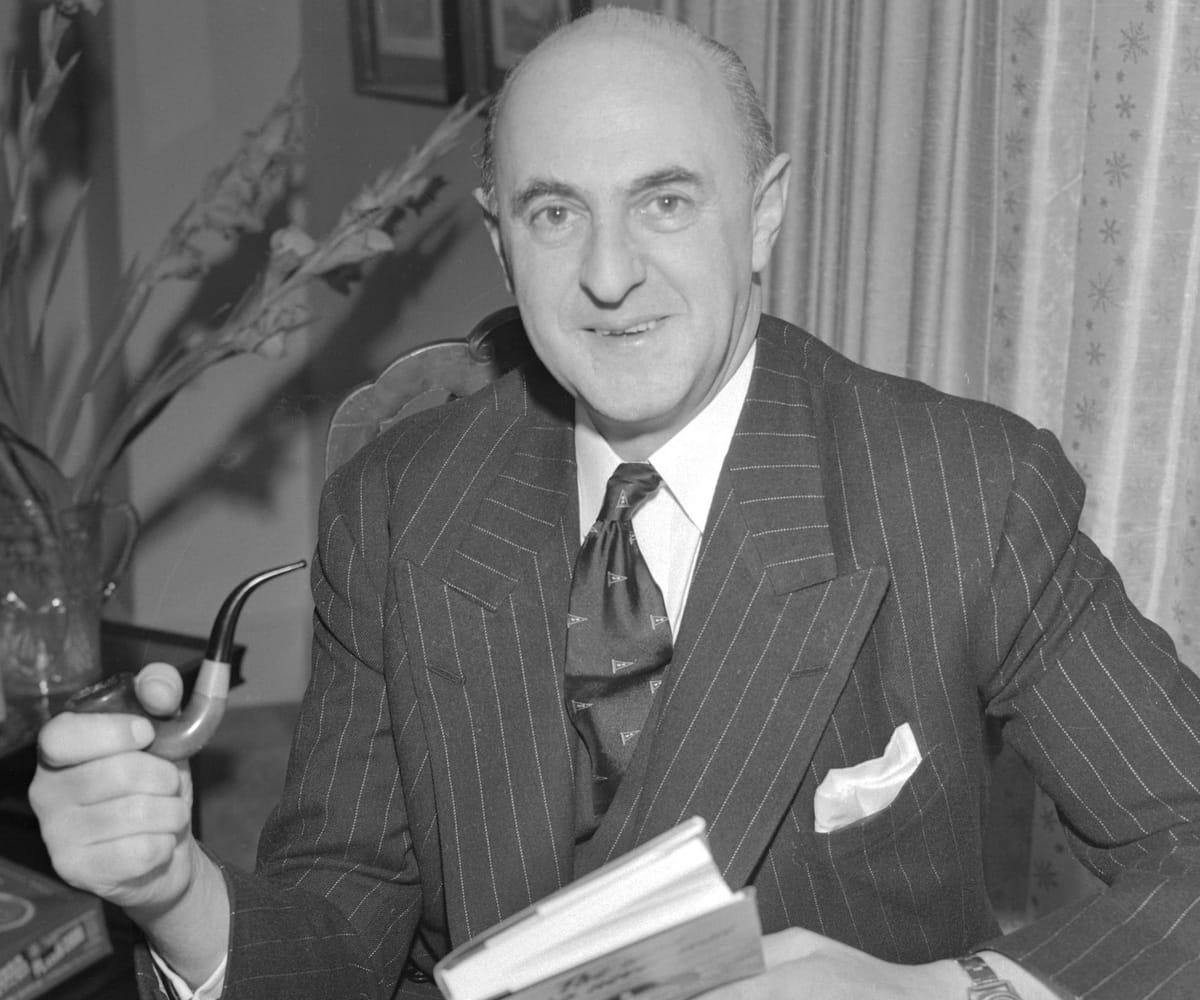
The show is a lot of fun, and one of the most successful new British musicals of recent years. It achieves much of its comic effect through its depiction of the M15 officers as public school-educated toffs seeking adventure and excitement, for whom espionage is one great jolly and the aim is power and social status (‘some were born to follow but we were born to lead’). As a result, the only thing the show really lacks is stakes, a clear sense of why the story matters; of what the consequences would be if the M15 officers failed. The initiator of the plan is Ewen Montagu, depicted in the show as the poshest of the posh, an arrogant but brilliant aristocrat. And he was those things. But because of my area of interest, it took me no time at all to discover one thing Operation Mincemeat doesn’t mention about him; Ewen Montagu was Jewish.
The Montagus were one of the leading Anglo-Jewish families, part of the set who climbed their way into the heykher madregas of British society in the 19th century, part of the group which Chaim Bermant termed ‘The Cousinhood’. Louis Samuel Montagu, Ewen’s father, was the president of the Federation of Synagogues (which his father, Samuel Montagu had created), and the founder of the (anti-Zionist) League of British Jews. His aunt and uncle were Lily Montagu, founder of the Jewish Religious Union (later Liberal Judaism) and Edwin Montagu, Secretary of State for India. Ewen himself was deeply involved in Jewish communal life in the postwar era, serving as President of both the United Synagogue and the Anglo-Jewish Association. Jewishness was not incidental to Ewen Montagu.
It's true that Montagu didn’t mention his Jewishness in his 1953 account of the plot, The Man Who Never Was – perhaps he wanted to play it down in the postwar context. But it is undeniably relevant context. I simply do not believe that being Jewish was ever irrelevant in Europe in the 1930s and 1940s. Even if one did not want to identify as a Jew (and Montagu did) – the structural racism implemented by Nazism left no Jew unscathed, even those living under British rule. Montagu would have been well aware of claims from British fascist circles that the war was being fought ‘for the Jews’, that Leslie Hore-Belisha had been dismissed as Secretary of State for War precisely to rebut such claims, and aware that British Jewish leaders were engaged in an excruciating choice of whether to talk louder about Nazi mass killings or to keep quiet and support Britain’s war effort, which offered the best chance of stopping them. For Montagu, his decoy plan would have represented the possibility of halting the mass destruction of European Jewry, his coreligionists and probably distant relatives.
I get why the show didn’t want to focus on this. The Holocaust doesn’t make great material for musical comedies, although Mel Brooks had a good go with Nazism in The Producers. But without changing the tone of the whole show the writers of Operation Mincemeat could have included something about Montagu’s Jewishness. It would have made the show stronger; showing why the scheme might matter to Montagu, and more broadly what the stakes were for winning or losing the war. In British popular culture, the suggestion is sometimes made that had the Nazis conquered Britain, everyone would have been forced to speak German and generally be bossed around. Nazis get depicted as bad because they were foreign and authoritarian rather than because they were genocidal fascists. As a result, the Second World War gets depicted as exciting and nostalgic, rather than an absolutely terrifying period in which some 70 million people died, and Britain came close to being conquered.
To focus on the positive, had Montagu’s Jewishness been referenced, it would have told a very significant Jewish story. Given his crucial role in the plot, I think we can describe him in those most cliched of terms, as a Jewish hero; one whose story is intertwined with that of modern Britain. And this reminds me of all the other British Jewish stories that remain untold, or underemphasised, or with their Jewish components omitted. I was recently given a copy of Liz Berg’s 2020 book Jewish Folktales in Britain and Ireland, which sounded like exactly what I was looking for. Excitingly, its contents page lists a range of British locations: London, Ramsgate, Oxford, Norwich, Hull etc, with one or more stories for each place of Jewish historic settlement. But it turns out that the stories are not truly of these places; they are classic Ashkenazi or Sephardi folk tales, that Jewish immigrants are presumed to have brought to these places, with some local names and places added. Each section starts with a brief description of Jewish history in that town, which is excellent, and there are a few cases that have been told to Berg by British Jews, and these are the highlight of the book. An example is the tale of how Barnet Levy first became a pedlar in Falmouth and learned to save time by saying his daily Amidah prayers without alighting from his horse. But there are not enough of these, and it’s not often clear which actually occurred in Britain, and which have been imported. And this is a shame, because there are so many great stories to tell.
Tony Kushner’s The Jewish Pedlar centres on the extraordinary story of the 18th century Jewish murderer Jacob Harris, and how his gibbeting post (yes, it’s gruesome) became a site of local memory. It tells other great stories too, of the murderous Jewish Chelsea gang later in that century, of a range of other peddlers, and of Kushner’s grandfather’s involvement in the global egg trade. Joanne Rosenthal has recently promoted the work of her aunt, better known as the Manchester 1980s ‘housewife superstar’ performer Avril A. I reckon every British Jewish family has at least one truly great yarn or mayse, bubbe or otherwise. At least one absolutely cantankerous relative, a rosha rogue, a shvartse shefele in the mishpoche. I believe that there’s always a communist aunt, uncle, or cousin somewhere, even if everyone pretends they don’t exist. Such figures always have extraordinary stories around theme, whether it’s about crime, shady business dealings, radical politics or simply screwing over their own family. Let’s tell these tall tales, the odder the better. Nothing is more deleterious to the flourishing of British Jewish culture than middle-class aspirations to decorum and propriety.
Our rabbis, past and present, offer a rich seam of stories. I want tales of Reverend Saul Amias, the socialist, CND-marching minister of Edgware United Synagogue from 1931 to 1972. Of Yankev-Meir Zalkind, the anarchist rabbi of Whitechapel; of Rav Kook’s WW1 stay in Britain, when he wrote letters to get yeshiva students out of military service; of Israel Mattuck, Lily Montagu and Claude Montefiore, the eccentric and charismatic founders of Liberal Judaism. Even in our days, Jeffrey Newman, who may well have made British rabbinic history when he chose to be arrested as part of an Extinction Rebellion protest in 2019 at the ripe age of 77. And the chain-smoking Lesbian Feminist New Yorker Sheila Shulman, who died in 2014, is surely overdue for a Buberian ‘Tales of the Hasidism’ treatment and given an appropriate level of mythologisation.
And would it be so terrible if a degree of supernaturalism crept into these stories? A touch of the ghostly, or the magical can improve even the most prosaic of tales. We used to have this in Jewish culture – Rebbes or Hakhams known to do miracles, making their burial places sites of pilgrimage, like Rebbe Nachman’s remains to this day in Ukraine. Christians are good at this kind of things. Coming up with miracles that occurred in a particular place, making that spot a religious site henceforth, a convenient manoeuvre for relocating the locus of your religion from the middle east to the places where you currently live. We could do the same thing – build stories of miracles that happened in this place, that centre our existence here on Ha’aretz Hazeh - the land on which we reside. I can even imagine rewriting and reclaiming anti-Judaic folk myths, like Little Sir Hugh, of whom there exists a ballad. The original claims that the Jews of Lincoln enticed him in and then murdered him, becoming a key pillar of the blood libel. But let’s tell what I imagine actually happened: he was unwell (not exactly unusual in the 13th century); he went to visit some Jewish friends, who invited him in out of neighbourly hospitality; he died of his illness while there; the Jews got the blame. Reimagining our medieval Jewish past, including such figures as the poet Meir of Norwich, offers so many narrative and creative possibilities for how we understand our presence here on these shores.
So this is my suggestion for a Channukah / New Year’s resolution. Let’s tell our stories: both the heroic and the embarrassing, the simple and the strange, those of our celebrities and ordinary Yoysef-shmos. And when a major British story is told, in which Jews played a role, let’s not be afraid to point it out. We are constructed from the broader tales of Albion, and Albion itself is woven out of our stories.
Buy me a cup of tea here...