The Fire of North London
We need to stop jumping to conclusions after antisemitic attacks

The year 1960 saw an international swastika outbreak. It began on Christmas Eve 1959 in Cologne, West Germany, with a defacing of a memorial and the words ‘out with the Jews’ daubed on a synagogue and with swastikas painted on the entrance. Over the next six weeks, there were around 1000 incidents of swastika daubing internationally, across Europe but also in North America, South America and Australia. Around 40 such incidents were recorded in Britain, beginning with the daubing of ‘Juden Raus’ on a synagogue in Notting Hill. It eventually transpired that while most subsequent incidents had been perpetrated either by neo-fascist groups or by individuals acting alone, the German outbreak was started by East German Communist agents, as an attempt to sow division and weaken the West German state.
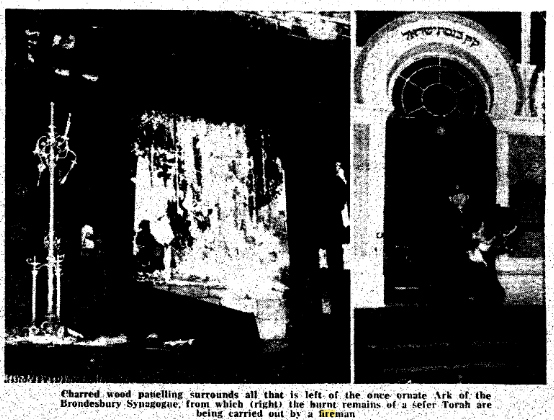
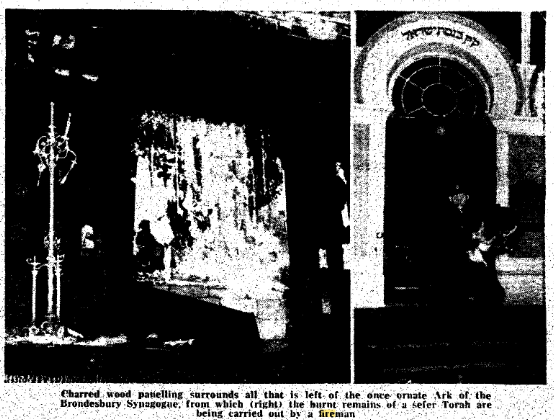
Five years later, in 1965 there was a string of arson attacks on London synagogues. Synagogues in Brondesbury, Edmonton, Tottenham, Bayswater, Boreham Wood, Palmers Green, Finchley Road, Stanmore, Clapton, and Ilford were all targeted during a five-month period, alongside a range of other Jewish buildings, and the Brondesbury synagogue (then a very major one) was almost burned to the ground. This was a period when the Board of Deputies and the Jewish Chronicle preferred to play down threats, and as far as possible suggest they might have been accidental. As the wave went on this view seemed increasingly difficult to justify, and it must have been a very scary period for British Jews, waiting to see which synagogue would be targeted next. More militant activists such as AJEX and the 62 Group believed them to be the work of neo-fascists and they turned out to be correct. Members of the National Socialist Movement, a neo-Nazi party led by Colin Jordan which had held an infamous rally in Trafalgar Square in 1962, were convicted for two of the arson attacks. It turned out that the attacks were masterminded by Jordan’s wife Francoise, née Dior. When Francoise returned to the UK in 1967, she was arrested and jailed for eighteen months for having incited the NSM members to carry out the arson attacks. The security that synagogues had instituted during the attacks was stepped down; the wave was over. What must have seemed like an omnipresent threat turned out to be the work of a very small number of fascists, incited by an eccentric French heiress.
This history may be helpful in thinking about the arson attacks on Hatzola ambulances in Golders Green, if only to remind us that such events are not unprecedented. At this point the threat seems big and scary – but it may turn out to very localised and short-lived. At this point we simply don’t know who carried out this attack and what their motivation might have been, and we should stick to condemning it, refraining from jumping to conclusions. I think there are at least six possible groups who might have perpetrated it.
First, fascists, the perpetrators in 1965, and the traditional antisemites. We have become used to the far-right having moved to an apparently philosemitic, pro-Zionist position, typified by Tommy Robinson, but there are newer groups which have returned to traditional fascist antisemitism, with the most prominent group in Britain being Patriotic Alternative. I came across them a couple of years ago when the Muslim media hub 5 Pillars shamefully conducted an interview with its leader Mark Collet. Patriotic Alternative, as an explicitly antisemitic white nationalist group, could certainly be behind this. Or it could be a group affiliated to Islamic State; the groups that carried out the attacks at Heaton Park Synagogue and Bondi Beach both were. I have written recently on how IS and its affiliates can credibly be viewed as fascist; and how they are motivated by classical antisemitism, and only use Palestine instrumentally, as a recruitment tool. Given the sheer number of attacks on Jewish targets by IS and connected groups this feels like a genuine possibility. It could, and this is the option being suggested by much of the media, have been carried by a group affiliated to the Iranian regime, as a salvo in the current war. Such a group has apparently claimed credit, Harakat Ashab al-Yamin al-Islamiya, an organisation which only emerged a few weeks ago and has in that time taken credit for several attacks across Europe. This all seems a bit too convenient to me – perfectly timed to emphasise the antisemitism of the Iranian regime and to boost support for the war against it. I would have thought that an Iranian group would have chosen an Israeli target – the embassy, an Israeli restaurant etc. Hatzola is one of the least Israel-affiliated organisations in the British-Jewish community, making it a strange target if the aim is to avenge the US-Israeli war on Iran.
Another possibility is a Palestinian group, taking revenge for the genocide in Gaza and ethnic cleansing of the West Bank, along the lines of the Washington DC shooting of last May. It would have to have been rogue individuals or an unknown group for this theory to work since there are not active Palestinian military groups carrying out attacks outside Israel/Palestine like there were in the 1970s and 1980s. Again, the choice of target does seem to mitigate against this explanation; historic attacks in Britain, were largely against Israeli or Zionist targets. This would be unusually sloppy for Palestinians. A separate possibility is another rogue state actor – i.e. Russia. The motivation here would be to cause chaos and social division, specifically adding to tension between Jews and Muslims. We know that Russia has done this kind of thing in the US; used sock puppet social media accounts to stir division between ethnic groups, originally to weaken the Democrats and help Donald Trump be elected, an echo of 1959. Finally, it could be the work of unaffiliated individuals. It was certainly a low-tech, low effort attack. It could have been the work of people radicalised by the wars in Gaza, Iran and Lebanon, and who are unable or unwilling to distinguish between Israeli and diaspora Jewish institutions. Perhaps they were radicalised by X’s algorithm’s, and specifically by those who have portrayed charities like the Shomrim or Hatzola as ‘Zionist’; as representing Jewish separatism or an attempt to impose ‘Jewish supremacy’ in Britain. A few radicalised individuals unconnected to wider networks can cause significant damage.
At this stage we don’t know which of these explanations is the correct one - two arrests have been made but no details about them given. Given that, I suggest we stop speculating. The explanations laid out above are very different and would require very different measures in response to them. Some of the explanations connect to wider public trends and discourses while others do not. Consequently, I suggest we wait to see what the police can discover before we jump in. The rush, by CST spokespeople as well as much of the media, to assume Iranian culpability is unhelpful and clearly motivated by the project of getting the British government to proscribe the IGRC. Moreover, even the way the attack has been categorised needs to be overhauled. It is not wrong to describe the attack as antisemitic – it is an attack on a Jewish charity, presumably because it is Jewish (though this too remains to be clarified). But the term has become so vague and capacious as to be analytically useless. It is forced to cover everything from tropes to microaggressions to unconscious bias to hyperbolic criticisms of Israel to criminal damage to physical attacks to mass murder. No single word can do all of this and remain meaningful – and the same applies to the word racism.
Given all this, when politicians pledge to do better on antisemitism, what are they really saying? That they will lower the number of ‘antisemitic incidents’ in the coming year? That seems unlikely, since what is and isn’t counted as an incident by CST remains opaque and questionable. Or that they will ensure there will be no more attacks like this one, or like Heaton Park? That seems an impossible task, especially given the continuing wars in the Middle East that surely make such attacks more likely. Or that they will try to change attitudes so that people are less hostile to Jews? That also seems incredibly challenging, and setting Jews against other minorities, as politicians are determined to do is surely detrimental to that cause. Is it even possible to make people less prejudiced against one group of people without tackling prejudice in general? And can we really expect significant progress without an end to Israel’s wars in the Middle East and a just long-term solution in Israel/Palestine?
In the absence of any such clarity, right-wing politicians fill the gap with their single solution: blame Muslims. Let less Muslims into the country, curtail the rights of those who are here; try to present their voting in large numbers as a problem and try to prevent them from organising politically. The fact that it’s a politician like Nigel Farage, a schoolboy Nazi who abused Jewish students that is proposing this should surprise nobody. Islamophobia and antisemitism are joined at the hip, impossible to separate. Both present their targets as seeking to dominate and take control over society; in reality, all Jews and Muslims want is not to be hated and to be left alone.
I’m not putting forward any answers here. I don’t know how we best tackle the various phenomena commonly described by the word antisemitism; or how we make Jews and all minorities safer, only that we will only be safe when all of us are. Maybe it’s helpful to state when we don’t know as well when we do. In this case I am simply advocating for waiting for facts to emerge rather than drawing on pre-made solutions. If we can work out precisely who would want to set fire to community ambulances, and what motivated them, we might stand a chance of dealing with it. Maybe, just as in 1960 and 1965, the threat will prove to have come from a small unrepresentative group or a state actor, and will not be long lasting, or part of a wider phenomenon. After all the 1960s have gone down as a good and safe time for British Jews. The Hatzola arson attack of 2026 may be as little remembered in future as the swastika epidemic of 1959-60 and the synagogue arson attacks of 1965. Gam zeh ya’avor: this too shall pass.