The Futility of Progressive Judaism's Attempt to Rescue Zionism
My chapter from a new book exploring Progressive Judaism's relationship to Zionism and to the State of Israel

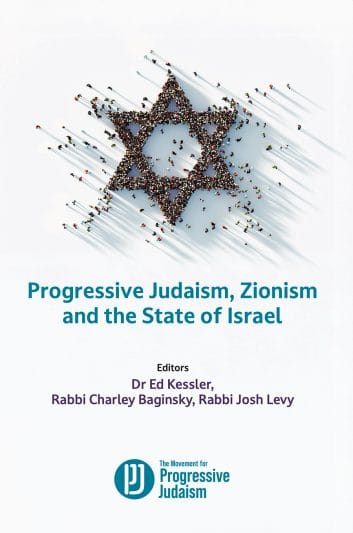
I recently contributed a chapter to the book Progressive Judaism, Zionism and the State of Israel. Unfortunately the only way to buy it is here, from Amazon. The book is the first publication of the newly merged Progressive Judaism, and I suspect the primary aim is to place it on the map, and show that it can make a serious contribution to current debates. The vast majority of the contributions are by Progressive Rabbis, alongside a handful of chapters by others, largely Jewish communal professionals, albeit ones connected with Progressive synagogues. Aside from the Editor Ed Kessler, I’m the only academic in the book, and more significantly, mine, shared below, is the only chapter to take an explicitly non-Zionist stance. A few others come close, such as that of Rabbi Howard Cooper, and others, like that of Rabbi Danny Rich, demonstrate the existence of non- or anti-Zionist trends in Progressive Jewish history. I don’t think the inclusion of someone with my politics is terribly significant – I was originally going to co-write with a Rabbi so probably got in via the back door. What is more interesting is that the book’s primary Editor, Dr Ed Kessler, asked me to expand on the political implications of my argument in the conclusion – the politics of my piece would have been less overt without that editorial request. Perhaps Kessler at least could see the value of non-Zionism being represented somewhere within its pages. Or maybe they just thought some token inclusion of the Jewish far left and far right – i.e. me and Rabbi Andrea Zarnado – would give the book a veneer of balance and strengthen its liberal centre.
What I think the book is ultimately trying to do is to rescue the term Zionism, by defining it in ways that are acceptable to Progressive Jews / liberals. The website of the new movement states that ‘The Movement for Progressive Judaism is a Zionist movement – committed to there being a Jewish, pluralist and democratic State in the historic homeland of Israel’ whilst adding that ‘our leaders, rabbis and cantors are now engaged in formulating a detailed framework around our relationship with Israel.’ Which is essentially to say – we don’t have an agreed policy yet, but it’s definitely going to be a Zionist one. It appears that the CEOs believe that for the movement to define as Zionist is necessary to gain the communal respectability they crave (and crave it at all costs, even if it means sharing a platform with Reform UK politicians). At the same time, they are aware of the huge diversity of opinion within the Progressive rabbinate about Israel, including many who are strongly critical of the state and its treatment of Palestinians. They try to square the circle by defining Zionism in extremely loose ways, sometimes with reference to pre-state Zionism(s), with the result that they define it in a way that has nothing to do with Zionism as it is currently practiced in the state of Israel. This book then, is an attempt to rescue Zionism, through making it mean something other than what it materially means today.
This point can be illustrated by the chapters by CEO’s Charley Baginsky and Josh Levy, helpfully placed next to one another. In her chapter: ‘Land, Body and Covenant after October 7th: Toward a Jewish Feminist Theology of Progressive Zionism’ Baginsky takes a classic ‘third way;’ approach, arguing that in response to October 7th and the war in Gaza, some Progressive Jews responded ‘by distancing themselves from Zionism altogether’, while others ‘responded ‘by sacralising Zionism, treating critique as betrayal’. In common with many of her articles and speeches, Baginsky seeks to avoid such a binary choice, calling for ‘a language capable of holding attachment, fear, responsibility’. After an interesting detour through feminist theology (referencing Judith Butler, who Baginsky surely realises is an anti-Zionist), the chapter states that Zionism can be ‘understood as a theology of presence rather than an ideology of possession’ which sounds rather close to a non-Zionist discourse of connecting to the land without sovereignty but then the author adds that Zionism should not be reduced to responsibility alone, given that ‘Jewish attachment to the land is sustained by memory, prayer and longing as much as by ethics’. She suggests that ‘the challenge…is not whether Progressive Jews can remain in relationship with Zionism’ (I would say that this is precisely the challenge) but ‘how that relationship is articulated and lived’. In other words, Progressive Jews must be Zionists, but what the term means is up for grabs. The implications are left deliberately opaque but Baginsky is basically calling for the continuation of Zionism and the State of Israel, tempered with better behaviour, ‘with humility, care and ongoing ethical reflection’.
Levy’s chapter attempts to reclaim the concept of religious Zionism for Progressive Jews. He argues that in Jewish sources, the right of Jews to the land of Israel is conditional, requiring ethical behaviour to be sustained: ‘Jewish presence on the land is dependent on the behaviour and obedience of those to whom it has been given’. Levy then notes that this system has broken down, that ‘Religious Zionism has come to reject any concept of conditionality in the relationship with the land’, and that the Jewish people and the Jewish state have become treated as inherently holy, ‘irrespective of moral behaviour’. In this, Levy has essentially laid out the religious anti-Zionist argument. The tradition only grants the Israelites the land if they behave justly there, and the story of our texts is one of them repeatedly failing to do so and thus losing it. Modern Zionism has jettisoned that tradition, and treats the land as an idol, a new golden calf. But inevitably Levy can’t just leave it there. As if held hostage to his own political project of keeping Progressive Judaism Zionist (or by the UJIA?) he adds: ‘We do not suggest that this historical connection of People Israel with the Land (his capitalisation) is, in any way, conditional. The texts cited above do not comment on the legal right of Israel as a modern state to exist nor on the reality of the Jewish experience of antisemitism in the Diaspora. Nor does the idea of conditionality imply disloyalty of lack of support for Israel.’ This ostensibly innocuous caveat undermines Levy’s entire argument. If conditionality can only work within the framework of hasbara norms, then what good is it? Like Baginsky, he is reduced to arguing that Israel should continue to exist but that it should try a be a bit nicer since ‘God ‘cares not only about our religious life, but how we behave and the kind of society that we build’.
What Baginsky and Levy cannot bring themselves to acknowledge is that the only way Israel could meet minimal standards of just behaviour would be by ceasing to be a Jewish state and instead granting equal rights to all Israelis and Palestinians between the river and the sea, and that such a transformation would be the end of Zionism as we know it.
If the book’s aim is to rescue Zionism in some idealised form, it ultimately fails. What comes across very clearly is how horrendous Rabbis and Cantors have found the period since October 2023 – attempting to hold together increasingly fractious and divided communities in a way they have never had to do previously. In a community where both Kahanist and anti-Zionist views have both been growing, the Liberal Zionist centre simply cannot hold. I suspect that in retrospect this book will be viewed as a last hurrah – a final attempt to maintain the idea of Progressive Judaism as Zionist. It surely cannot be long before the movement is forced to concede – at the very least – that it is a movement that contains Zionists, non-Zionists and anti-Zionists within its ranks, and that all are equally welcome. It will be the first of the UK mainstream denominations to take such a stance, but I suspect it will not be the last.
His is hardly the most left-wing voice in the book (he publicly condemned Corbyn for antisemitism in 2018) but Rabbi Jonathan Romain’s chapter is perhaps the most surprising. Romain is brave enough to consider that the State of Israel may cease to exist, asking ‘what would its effect be on Jewish life in the UK once the shock had dissipated and efforts made to give refuge to any Israelis who came here.’ Romain notes that this would hardly be the first period in Jewish history without sovereignty and implies that while Israel’s fall would hardly be desirable it would not be the end of the world: ‘Jewish home life would continue. So too would synagogue services and activities, while the feeling of personal Jewish identity would remain, as well as a sense of solidarity with Jews elsewhere in the world.’ He concludes by saying that Israel is ‘not the sum total of Jewish creativity, not its only future. Within the sweep of 4000 years of Jewish history, an independence of only seventy-eight years make it seem like a pop-up state. We neither dismiss it not worship it, but nor do we depend on it.’ Indeed. The end of Israel in its current form may well come sooner than most people think. The primary task for Progressive Jews is to think about what Judaism will look like if and when that occurs, and tailor our actions in the present accordingly.
And All the Children of Adam
First published in Progressive Judaism. Zionism, and the State of Israel, eds. Dr Ed Kessler, Rabbi Charley Baginsky and Rabbi Josh Levy (London: Progressive Jewish Press, 2026)
Growing up in a Liberal synagogue in North London in the 1980s and 1990s, the Liberal liturgy was simply part of the furniture – the only liturgy I really knew. I’m just about old enough to remember Service of the Heart (1967), and the congregational grumbles when an early draft of Siddur Lev Chadash was trialled in 1992. I also took for granted the universalism of the liturgy, which I later learned had much to do with the primary Liberal liturgist and intellectual: John Rayner, who grew up in Berlin and came to Britain aged 15 on a Kindertransport in 1939.
In my synagogue, the version of Oseh Shalom I experienced was: ‘Oseh Shalom Bimromav, Hu Ya’aseh Shalom, Aleinu V’al Kol Yisrael, V’al Kol B’nei Adam’. I had no inkling that there was anything non-traditional about this formulation, that ‘V’al Kol B’nei Adam’, and all children of Adam (i.e. all people) was not part of the classic prayer. It was only later, when I began attending services in Orthodox, Masorti and even Reform communities that I discovered that my version was not the standard one, that all the children of Adam usually went unmentioned, replaced instead by the coda ‘V’imru Amen / and we say amen’, which felt like a poor substitute. At a certain point I began to wonder about the meaning of this divergence – did other Jewish denominations not care about other people? Were the Jewish universalism and progressivism I imbibed from Rayner’s liturgy and from my family aberrations rather than the norm?
Zionism played little role in my upbringing, but since I came of age during the Oslo peace process I imbibed in my teenage years a basic sense that the Israel left was good, the settler right was bad, and that a two-state solution was on the way. I took part in a gap year programme in Israel and during this I met Jews who, whether Orthodox or simply traditional, were politically right-wing; a new and extraordinary notion to me. These were Jews who were not universalists but rather nationalists, they were primarily concerned not with the whole world but with the Jewish people and the Jewish state. Their focus seemed to me less with how to bring the messianic age of peace and justice, Liberal Judaism’s view which I associated with the multicultural socialism of the post-1968 new left, but rather with how to protect the Jewish people from hostile enemies and ensure the ongoing survival of the state of Israel. I have spent much of the rest of my life trying to understand this dissonance. Which view was the more authentically Jewish one, mine or theirs? Should we pray for the peace and well being of all peoples, or only for Jews? And what did this have to do with the State of Israel?
The words Oseh Shalom Bimromav are taken from Job 25:2, spoken by Bildad the Shuhite, one of Job’s comforters. From here, the traditional liturgies built the line that is included at the end of each Amidah, the end of each Kaddish and as part of Birkat Hamazon. I will take a historic view of Progressive siddurim to see when and by who this classic text was revised. Inevitably this cannot be an overview of the concept of universalism in Progressive liturgies, since that would require far greater length, but rather looks at the issue through the prism of this one specific prayer. Oseh Shalom is a prominent, short and memorable prayer, that, thanks to certain musical settings, is well remembered by Jews who do not recall many other pieces of liturgy. The choices made by liturgists in respect to it are thus particularly consequential.
The starting point is inevitably with the origins of Reform Judaism in 19th Century Germany, and with related German-Jewish siddurim published in the United States. The Ordnung der Öffentlichen Andacht für die Sabbath und Festtage des Ganzen Jahres, published in Hamburg in 1819 and considered the first Reform siddur has the traditional text for the conclusion of Kaddish, as does David Einhorn’s Hebrew-German Olat Tamid: Gebetbuch für Israelitische Reform-Gemeinden, published in New York in 1858. This pattern continued in later German prayer books, all the way to Tefilot le-Khol Ha-Shanah: Gebetbuch für Das Ganze Jahr published in Frankfurt in 1929, John Rayner’s beloved ‘Einheitsgebetbuch’ of German Liberal Jewry, which uses the traditional liturgy here.
David Einhorn’s Hebrew-english revision Olat Tamid: Book of Prayers for Israelitish Congregations (1872) however has a revised text: ‘Aleinu V’al Kol Banav’, meaning ‘on us and on all his children’ although Einhorn leaves the second half of the verse untranslated, simply putting ‘He who maintains peace amongst his heavenly hosts’. Einhorn added similar language to the Sim Shalom prayer: Aleinu V’al Kol Banekha (in us and all your children) and L’vareikh et Kol Ha’amim (Bless all peoples), all of which remain untranslated, indicating a possible wish by Einhorn not to emphasise the radicalism of his emendations. Contemporary Siddurim by Isaac Mayer Wise and Benjamin Szold do not include this change, whereas Max Landsberg’s 1884 Ritual for Jewish Worship uses Einhorn’s formulation, here accompanied by an english translation (‘May he who preserveth peace in the heavenly spheres bestow peace on us and upon all his children’). Wider historical sources, such as the 1885 Pittsburgh Platform offer important context but not explanations for this specific textual choice. It is tempting to suggest that it might have influenced Arthur Miller, who grew up in New York in the 1910s and 1920s, and whose play All My Sons, with Joe Keller’s closing insistence that lineage is not purely biological, seems a clear echo of the Einhorn phrasing.
There is another precedent from this era, found not in Oseh Shalom, but rather in the prayers offered for governments and monarchs. Such prayers in nineteenth-century American siddurs used grandiose language to appeal for the well-being of the United States, praying for the well-being of her non-Jewish inhabitants as well as her Jews. One such prayer was composed by the German-born Reform Rabbi Max Lilienthal for his siddur Ribon Kol HaOlamim, and asked God to ‘grant peace, goodness and a blessing on all the inhabitants of the land, that they may lie down with none to make them afraid’, with the Hebrew version using the phrase ‘Al Kol Yoshvei Ha’aretz’ (all who dwell on the land), derived from Joshua 2:9 and Jeremiah 1:14. A similar formula was utilised by British Chief Rabbi Joseph Hertz, first in his 1914 Prayer on the Declaration of War, which concludes by asking God to ‘hasten the day when thy tabernacle of peace shall be spread over all the children of men for evermore’, with the Hebrew phrase being ‘Al Kol Yoshvei Teivel Artzecha’ (all dwellers on your land). Hertz trained at the Jewish Theological Seminary in New York, so may well have known Lilienthal’s formulation. With this phrase, which (excepting the word ‘Artzecha’, your land) is found in Isaiah 18:3 Psalms 33:8, Lamentations 4:12 and in the Aleinu, Hertz took Lilienthal’s patriotic American formulation and turned it into a global one, a boldly universalistic position to take at the outset of the First World War. This phrase continued to be used in subsequent British prayers for the Royal Family and in the commentary for his 1942 edition of the Authorised Daily Prayer Book, Hertz claimed to have been inspired by ‘The Jewish humanist, Azariah de Rossi (1513-1578)’ who, according to Hertz, ‘maintained that, like the High Priest of old, Jews are to pray for the whole of mankind’. Hertz was highly universalist in his outlook, especially important given that his Chief Rabbinate was bookended by two world wars. He also, during World War II, amended the Channukah hymn Maoz Tzur, changing the vengeful ‘When You prepare the slaughter of the blaspheming foe’ to the pacifistic ‘When thou shalt cause all slaughter to cease’. Despite Hertz’ Orthodoxy, the pursuit of peace was worth changing the liturgy for.
Returning to Oseh Shalom, it is in a British Liberal siddur that the Oseh Shalom formulation with which I grew up was first introduced. The Liberal Jewish Prayer Book was composed by Israel Mattuck, the first rabbi of Liberal Judaism, and published in 1926, drawing on existing Jewish Religious Union (JRU) material. It is testament to Mattuck’s universalist outlook that he included many poems from non-Jewish writers in his 1926 book, writing in his introduction that ‘the best poetry speaks the language of universal religion’ and noting ‘the belief that Liberal Jews hold, that Divine inspiration is universal.’ Consequently, the Kaddish prayer here ends with V’al Kol Yisrael, V’al Kol B’nei Adam, V’imru Amen, which Mattuck freely translated as ‘He will grant peace unto Israel and all mankind, for he alone can grant peace’. While the Siddur does contain some footnotes, this emendation is not explained, nor is any source given. This implies that the change was previously part of JRU or Liberal Jewish Synagogue (LJS) liturgies, the latter being where Mattuck had served as Minister since 1912. Since Mattuck grew up in the United States and studied for the Rabbinate at the Reform movement’s Hebrew Union College in Cincinnati, it seems likely that he would have been familiar with Einhorn’s text, and Mattuck’s version does not fundamentally change its meaning.
Few later Siddurim on either side of the Atlantic followed Mattuck’s example. Basil Henriques Prayer Book of the St. George’s Settlement Synagogue (London, 1929) maintains the traditional text, as does the 1948 edition of the Union Prayerbook for Jewish Worship. The US Reform movement’s 1975 Gates of Prayer did not use the universalised text, nor did the UK Reform movement’s 1977 Forms of Prayer, despite its other innovations. Successor Liberal prayer books did use Mattuck’s revision, most notably Service of the Heart (1967) and Gates of Repentance (1973), both under the editorship of John Rayner and Chaim Stern (although Rayner was the dominant partner). Naturally these revisions continued in Liberal Judaism’s 1995 Siddur Lev Chadash; here Rayner and Stern also inserted similar formulations into peace-related prayers such as Hashkiveinu, Shalom Rav and Sim Shalom. Shalom Rav, for example, calls for peace to be bestowed on ‘Yisrael V’et Kol Ha’amim’, and the concluding blessing uses a traditional variant which simply blesses God as the source of peace, rather than only blessing ‘his people Israel’. It is tempting to conclude that the context of the early 1990s, featuring the Madrid peace conference of 1991 and the signing of the Oslo accords in 1993 provided the political context for this shift, although Rayner had long been a supporter of peace and territorial compromise in the Israeli-Palestinian conflict. The Movement for Reform Judaism, as the RSGB had rebranded itself in 2005, would be far slower to introduce the universalist clause. It would take until 2008, in its updated Forms of Prayer to introduce the change, in the form of ‘V’al Kol Ha’olam’, though there is nothing in the commentary or footnotes to draw attention to the change.
Despite the universalism of Mordechai Kaplan, the founder of Reconstructionist Judaism, it was only in 1994, that the movement began using ‘V’al Kol Yoshvei Teivel’ in its Kol Haneshama siddur. In a footnote, David Teutsch, chair of the editorial committee explained that the addition ‘logically completes the concentric circles of our aspirations - our care starts with our minyan, extends to the entire Jewish people, and radiates outward from there to all who share our planet.’ US Reform’s Mishkan T’filah made the same switch in 2006, as did HaAvodah SheBaLev, the siddur of Kehilat Kol Haneshama in Jerusalem in 2007. It would take further research to see if there were earlier precedents; if any chavurot, activist groups or alternative communities used one of the universalistic formulations in the 1970s or 1980s. But by 2008 all Progressive liturgies had finally adopted Einhorn and Mattuck’s approach.
Reflecting on the need for the universalist formulation, Rayner reflected in an LJS sermon in 1998 that:
peace is indivisible. So the prophet Jeremiah, in his famous letter to the Jews of Babylonia, exhorted them to seek the peace of the City to which they had been exiled, and pray to God on its behalf, ‘because in its peace you will have peace' (29:7). In other words, our enlightened self-interest dictates that we should pray for the peace of the society in which we live. But even if no Jewish self-interest were involved, it would still be appropriate that we should pray for the peace of the other 99.5 percent because they are our fellow men and women, created like ourselves in God's image, whom we should respect and love, and whose welfare we should seek, for that reason…How we conclude Kaddish is…a mere detail, but a detail of great significance because it shows to what extent we are conscious of the fact that, as the God we worship cares for all humanity, so should we.
It is surely relevant to consider the wider political outlooks of Einhorn, Hertz, Mattuck and Rayner that led them to make these liturgical choices. Einhorn was a lifelong radical, who lost a rabbinic position in Budapest due to opposition from the Austro-Hungarian government, and whose fervent abolitionism forced him to flee Baltimore for Philadelphia in 1861. Hertz was born in Slovakia and moved to New York at the age of twelve and studied at the Jewish Theological Ceremony in its early days, when it was neither Reform nor wholly Orthodox, and from where he developed a liberal, universalist philosophy. He spoke to both Jewish and non-Jewish audiences across the British empire and his famous Chumash (1929-1936) draws widely on non-Jewish sources for its commentary. Mattuck was well known for his espousal of progressive causes such as feminism, socialism, peace and anti-Zionism. Rayner, who was ordained and inspired by Mattuck, is best described as a radical liberal, supporting progressive causes as they emerged, such as race relations, social justice, environmentalism and gay rights.
Unlike the others, Rayner’s career took place in the post-WW2 era, in which discourses of Zionism, rebuilding after the Holocaust and Jewish peoplehood displaced the more universalist perspectives which had previously dominated Progressive Judaism. Rayner was part of that shift, restoring much liturgical material that previous generations had omitted, and, after 1967, creating in Gates of Repentance (1973) a Yom Kippur Additional service that fitted the new mood of Jewish peoplehood. But he insisted on combining that return to tradition with an ongoing commitment to universalism, perhaps inspired by the kind treatment he received from english clergy families who housed him after him came to England, perhaps also by the universalist responses to the Second World War which predominated in the immediate postwar years. Rayner understood that universalism was most tested when it came to the exercising of Jewish power in the state of Israel – he seemed to appreciate that Liberal Judaism and Zionism (in its hegemonic post-1948 form) were, at the very least, in tension if not directly in opposition to one another. His 1982 sermon condemning the Sabra and Shatila massacres and associated call for the Mourner’s Kaddish to be said for the (non-Jewish) victims of them is testament to how he maintained his conscientious universalism, even when the rest of Jewish community had moved in a very different direction. Anyone who grew up with the liturgies of Hertz, Einhorn, Mattuck or Rayner were inevitably shaped by them in the way that we came to see universalism as the norm and Jewish particularism as a deviation from it; in this sense we are all their children.
In recent Jewish or pro-Israel demonstrations in Britain, whether focusing on the Israeli hostages, supporting Israel’s war on Gaza or campaigning against antisemitism, Oseh Shalom has often been sung to melodies with strong connections to Israel. Either Nurit Hirsch’s 1969 setting, which became popular during the 1973 Yom Kippur war, or Steven Levey’s 2008 melody, latter written to mark the 60th anniversary of the State of Israel. In both cases the text sung has been the traditional one: V’imru Amen, with no V’al Kol B’nei Adam. This has felt unusually difficult: during what Peter Beinart has called the destruction of Gaza, and many prominent scholars have termed a genocide, the British Jewish community seems to have turned inward. It has been concerned about ‘our people’ (as if Israelis and diaspora Jews had become synonymous) – our hostages, our soldiers, our communities suffering from antisemitism. In this context the choice to prayer only for the peace of Yisrael and not Kol B’nei Adam has felt like a pointed one.
Rayner’s universalism was once viewed as over the top and somewhat comical, as per the letter to him from Jakob Petuchowski which concluded playfully ‘with all good wishes to you, your family and all mankind.’ That universalism now seems utterly necessary, but it is arguably the bare minimum, and we may have reached a point where it is inadequate. The need of the hour is surely to be more specific. One approach has been to specifically mention Muslims, probably originating in Arthur Waskow’s 2006 Mourners Kaddish in Times of War and Violence, which concludes with ‘V’al Kol Yisrael, V’al Kol Yishmael, V’al Kol Yoshvei Tevel / peace for all the children of Abraham, through Hagar and through Sarah — the children of Israel; the children of Ishmael; and for all who dwell upon this planet’. But even this doesn’t feel clear enough when there is one very specific people that is being oppressed by Israel, in the name of the safety of all Jews. It is for this reason that the recently published Tatir Tz’rurah, an explicitly anti-Zionist siddur, includes ‘V’al Kol Palastina / and all Palestine’. To name Palestinians (including both Palestinian Muslims and Christians), and Palestine in our prayers in this way feels like a necessary step. It is neither totalising universalism nor unthinking ethnonationalism but rather a recognition that the fate of the Jewish people is now utterly intertwined with that of the Palestinian people. If we cannot stand in solidarity with Palestinians in their moment of need, nobody will take Progressive Judaism’s claims to ethical monotheism seriously ever again.
Such a suggestion clearly has ramifications for where Progressive Judaism positions itself in relation to Zionism and the State of Israel, and my view is that the movement should not identify as Zionist. Whatever historical diversity may once have existed under the umbrella of Zionism, in its contemporary hegemonic form it opposes the emergence of a polity with equal rights for all between the river and the sea, and the return of Palestinian refugees to the places from which they and their families were exiled in 1948. I do not think the two-state solution remains feasible, or can provide full rights for the Palestinian people and believe that we should instead return to the vision of Martin Buber and Judah HaMagnes, as well as of Palestinian intellectuals like Edward Said, and call for a single democratic state with equality for all who dwell on the land. Such a step should not be difficult for Progressive Judaism to make, since both British Reform and Liberal Judaism were originally anti-Zionist movements, positions which only changed after statehood, and particularly after 1967. There are a range of alternate monikers that the movement could choose: cosmopolitan, implying the transcending of national borders; diasporist, indicating that diaspora is the better and more ethical alternative to sovereignty; or liberationist, suggesting that the movement prioritises the liberation of all peoples from oppression. Whatever term it chooses, it is vital to emphasise that the statist experiment of the last 80 years does not define Judaism; that Judaism prioritises justice rather than ethno-national continuity and that its concern is for all peoples, for all who dwell on earth.
Bibliography
Colin Eimer, ‘Joseph Hertz: A Chief Rabbi at War’, European Judaism 48:1 (2015) pp. 23-32.
Eric L. Friedland, ‘“Olath Tamid” by David Einhorn’, Hebrew Union College Annual, Vol.45 (1974), pp. 307-332.
Andrew Goldstein, ‘John Rayner: German, English and American Liturgist’, European Judaism 40:1 (2007), pp. 81-92.
Jakob J. Petuchowski, Prayerbook Reform in Europe: The Liturgy of European Liberal and Reform Judaism (New York: World Union of Progressive Judaism, 1968).