A Funny Thing Happened on the Way to the 90th Anniversary of the Battle of Cable Street
How the specific battle against fascism has been reinvented as a fight against a generalised 'antisemitism'

This is a longer version of a talk I gave at 'The Battle of Cable Street Ninety Years On: the Struggle Against Fascism and Antisemitism, Then and Now' on 6th October 2023, organised by the Birkbeck Institute for the Study of Antisemitism. The video of that event can be found here.
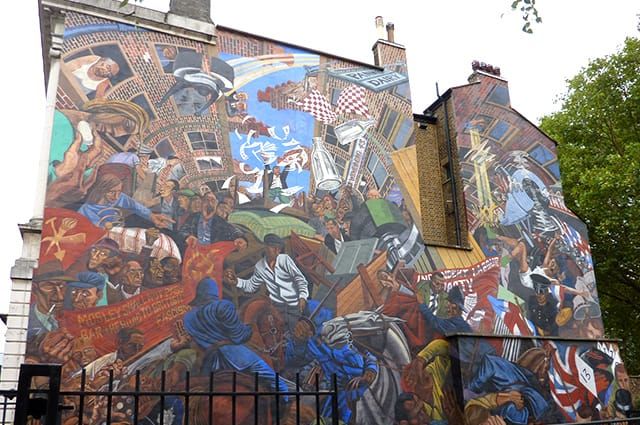
In 1998 Tony Kushner wrote a landmark article on the reception history of the Battle of Cable Street (included in his 1999 book with Nadia Valman). Kushner noted that it was little discussed in the 1940s, 50s and 60s outside the Communist party and the writings of those who had directly experienced it, but that this began to change in the 1970s. First came the 1970 BBC documentary Yesterday’s Witness, which brought the events of October 1936, as well as the name The Battle of Cable Street, to a much wider audience. Then came the growth of the National Front in the 1970s, and the anti-fascist movement began to find in Cable Street a usable past for the multi-racial struggle against fascism, particularly the relaunched Searchlight magazine which published a special issue on it in October 1976 to mark the 40th anniversary, the first such extended coverage since the 1930s. The Cable Street mural was initially commissioned in 1976 by Tower Hamlets Art Project and work began in 1979, only to be defaced by fascists in 1980. The mural was then completed by different artists in late 1982, providing an abiding site of memory for the battle.
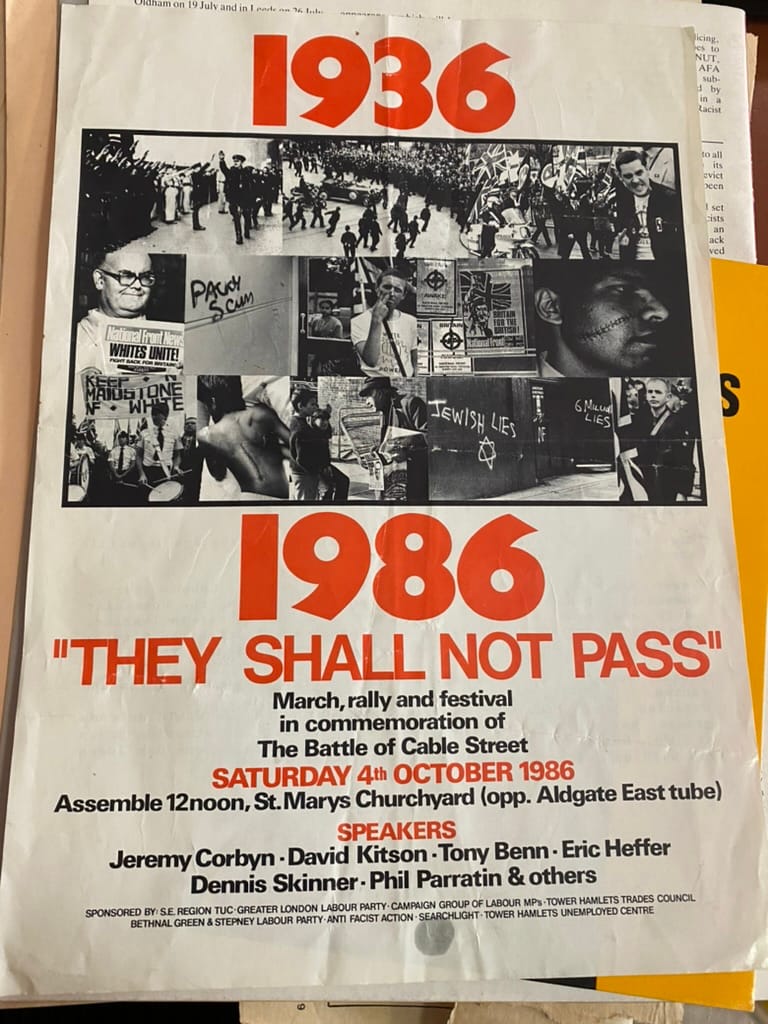
Four years later, the commemorative events of 1986 to mark the 50th anniversary were the most expansive by some distance and set the template for future decades. A flyer for the 1986 march listed as the main speakers Labour left figures Jeremy Corbyn, Eric Heffer, Tony Benn and Dennis Skinner, the Jewish South African anti-apartheid campaigner David Kitson, and the former Jewish Communist MP Phil Piratin. Clearly this was an event primarily of the left, but within that umbrella the Jewish left was well represented.
The people who were not represented, and who did little to mark the history of Cable Street, were the mainstream Jewish bodies, the Board of Deputies, Jewish Chronicle and Chief Rabbinate, amongst others. This was hardly surprising – in most Jewish accounts, the Board and the JC were the secondary villains of the story. The Board, infamously, told Jews to stay away because Jewish anti-fascism would inevitably fuel antisemitism, and the JC was the carrier of that message. In 1986 there appeared a couple of letters in the Jewish Chronicle: Raymon Kalman lamented that ‘organisers of the demonstration include, and are dominated by, extreme Left anti-Zionists’ and then noted the fate of the Soviet Jewish Anti-Fascist Committee, condemning any ‘any Common Front against Fascism which includes anti-Jewish extremists and extreme anti-Zionist Leftists’. The fact that the anniversary that year fell on Rosh Hashanah provided a convenient alibi for establishment Jewish bodies, who would have been unlikely to mark it anyway, though Martin Savitt, former director of the Board of Deputies Defence committee, was keen to clarify that the Board would not give the same ‘stay away’ advice in the 1980s. Overall, Cable Street was ignored by the Jewish establishment throughout the 1980s and 1990s.
But this year the situation changed dramatically. The Board of Deputies organised a major cultural festival to mark the 90th anniversary, with music, art and talks. And groups that can arguably be characterised as far right like Stop the Hate and Our Fight sought to join the main trade union led commemorations. What is happening here? Why has the Jewish mainstream and right suddenly adopted Cable Street, and how is Cable Street being repurposed to this end? I want to focus on the period since Tony Kushner’s article to try to understand the steps in the 2000s and 2010s that have led us to this point.
In the 1980s and 1990s. Cable Street was still primarily associated with Jewish Communists, socialist and anti-fascists as well to the British left in general. In keeping with this, coverage of the 60th anniversary in 1996 focused on Jewish communists who recalled their activities on that day at an event organised by the Cable Street Group which connected it to BNP attacks on young Bangladeshis in East London. But the 2000s began to see signs of change, at least in terms of mainstream communal organisations seeking to apologise for or defend their historic behaviour. For the 70th anniversary, in 2006, the JC ran a tongue in cheek editorial, apologising to readers for ‘allowing the JC to be swayed by the excessive caution of the Board of Deputies at the time’ and adding that’ on reflection it felt ‘that readers should have made their presence felt in large numbers.’ ‘Still, to be fair to the Board’ it added, we have found no evidence in our archives to suggest that it was planning an alternative anti-Blackshirt march in the Jews’ Free School playground.’ In the late 2000s the Board of Deputies took the decision to open the archives of its defence committee from the period, with the hope of rebutting the charges that the Jewish left had long levelled at the Board in the 1930s, and particularly its president Neville Laski. This opening facilitated doctoral research and a subsequent 2014 book by Daniel Tilles which argued that the Board had done more to counter British fascism than had previously been assumed, particularly in the period between Cable Street and the start of the Second World War.
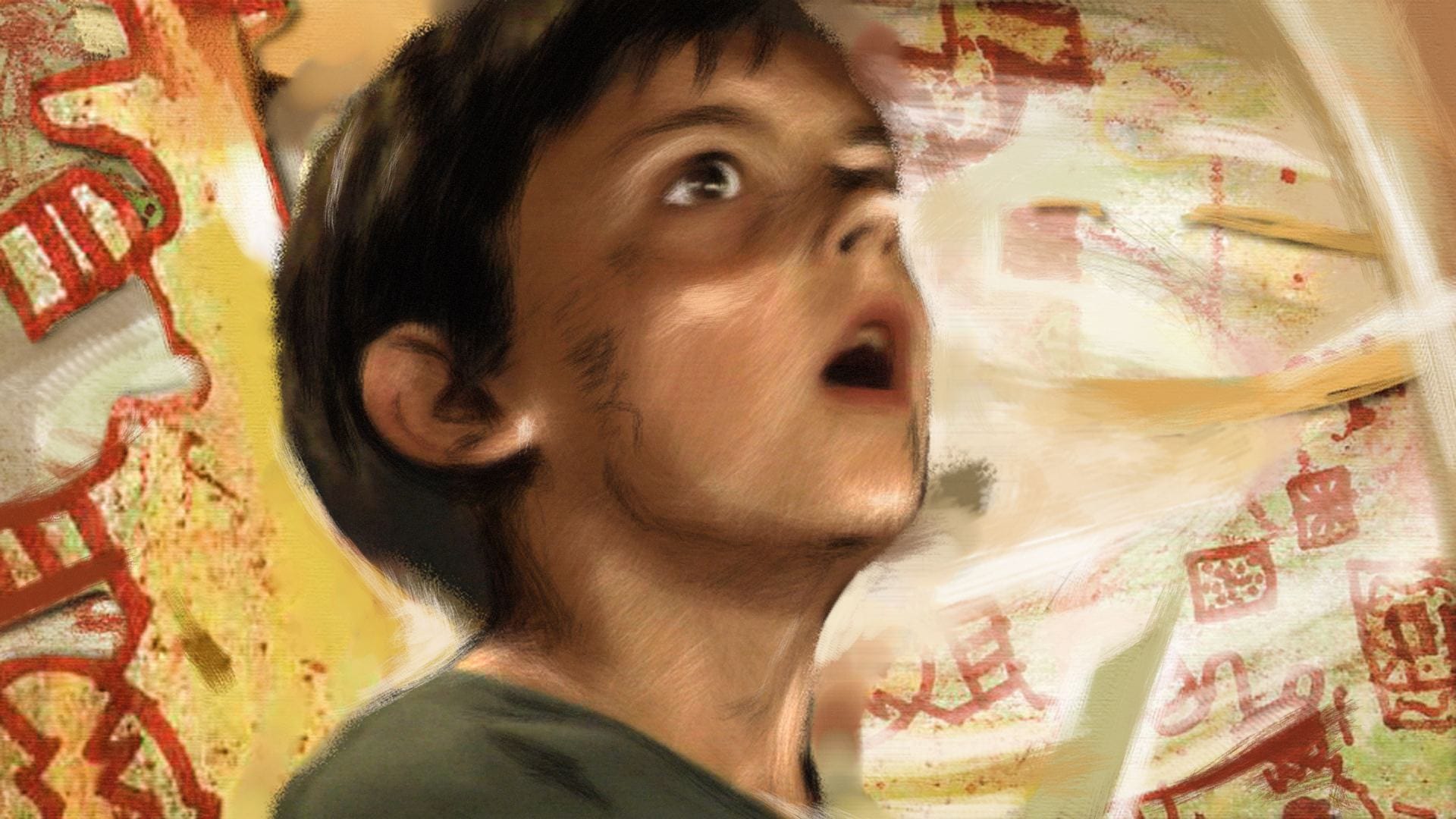
2007 saw the release of Yoav Segal’s short film The Battle of Cable Street, the winner of the Pears short film fund award of the UK Jewish Film festival. That it won this award shows that the more progressive parts of the Jewish communal mainstream were beginning to show an interest in the memorialisation of Cable Street. The film, which used animation to depict the events of 1936, featured a fictionalised version of Segal’s grandfather telling the story to a young Yoav, concluding with the real-life Cable Street mural. The anti-fascist struggle was firmly depicted in multi-racial terms, rather than as being specifically Jewish.
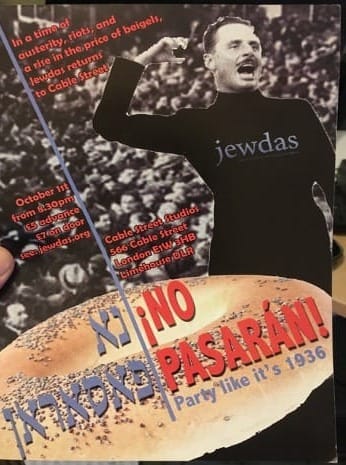
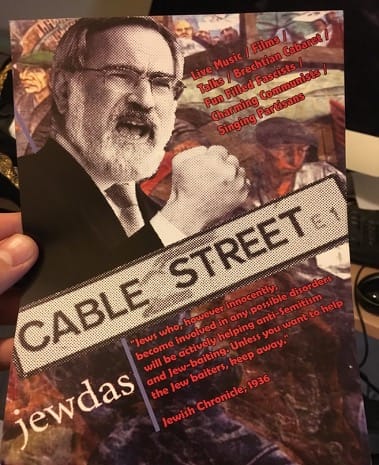
I was amongst the founders of the Jewish anarchist collective Jewdas, and for our second party, in autumn 2006, we plastered the walls with large posters of the Jewish Chronicle’s 1936 advice for Jews to stay away from the fascists. In October 2011, Jewdas held a specifically Cable-Street themed party, in Cable Street Studios, with a range of Yiddish, socialist and anti-fascist acts, including an electro-swing band and the singer songwriter Daniel Kahn. This kind of event was largely continuing the work of the Jewish Socialists’ Group in the 1980s and 1990s – holding up Cable Street as the high point of the Jewish left in Britain, in opposition to the culture of the Jewish mainstream or establishment. In 2011 that establishment was still barely commemorating Cable Street. So what changed? I suggest three staging posts between then and now.
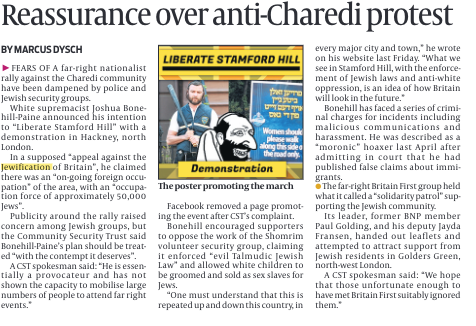
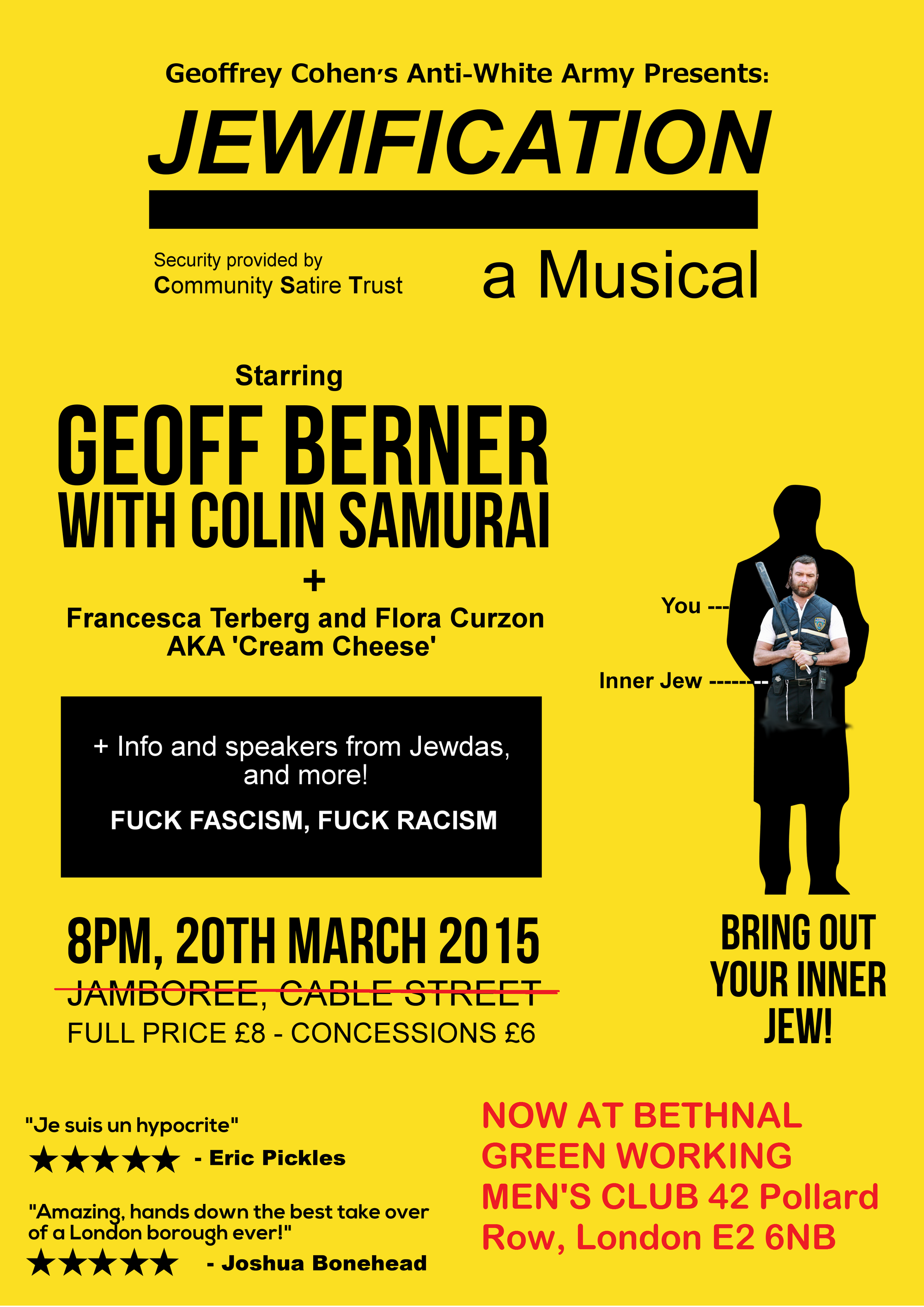
Firstly there were a series of protests in 2015 organised by Joshua Bonheill-Paine, a fascist who is apparently now repentant and recently appointed an anti-extremism advisor by Kemi Badenoch. The protests claimed to oppose ‘Jewification’, particularly the Shomrim community policing group, who were presented as trying to impose Jewish control over the area. The fascists managed to hold a demonstration in Stamford Hill, opposed only by activists from Jewdas (who marked it with a satirical gig, as shown above), and by the recently formed Campaign Against Antisemitism (CAA). Then as now, the Jews of Stamford Hill were not a priority for the Jewish establishment. The CAA were engaging in a new version of what Daniel Tilles called the defence debate – where an upstart Jewish defence group claims that the communal establishment is weak and is failing to protect the community from new threats. These taunts became more cutting when the neo-fascists announced plans to march in Golders Green. The combination of a group with explicit fascist antisemitic politics seeking to march through a heavily Jewish area made comparisons with Cable Street irresistible, and the CAA’s used the rhetoric of ‘They Shall Not Pass’. As the Jewish left and right planned - separate – demos against the fascist incursion the communal establishment felt compelled to intervene and persuaded the police to relocate the protest to a contained area in Whitehall. The feared Battle of Golder Green was thus averted, although in a bathetic coda the protestors quietly returned to the area on a different day and subversively filmed themselves eating a pork pie in the centre of Golders Green roundabout. These events inevitably began to make the communal leadership think that Cable Street might be a past that could be made usable if only they could wrest it from the left.
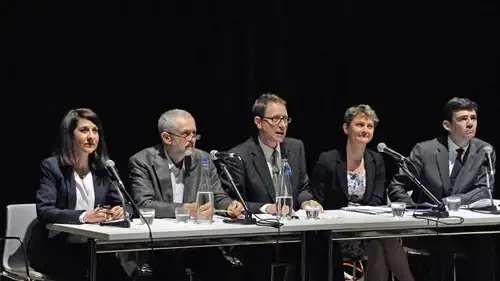
Just a few weeks after came the 2015 Labour leadership campaign in which Jeremy Corbyn was a shock candidate, and who immediately came under intense attack from Steven Pollard’s Jewish Chronicle. At a tense hustings at JW3, Corbyn spoke passionately of the importance of Cable Street and what it symbolised for the struggle against fascism more broadly. He noted with pride the presence of his parents at the battle and the memory functioned as an effective rebuttal of the already-emerging claims that he was an antisemite. This usage of Cable Street by a despised far left anti-Zionist politicians surely irked the communal elite – who felt that it was history that at some level belonged to Jews, if not to their organisations. ‘Were his parents silent at Cable Street?’ wrote Louise Mensch in the JC, contrasting this with his supposed silence in relation to association with antisemites. Steven Daisley took a different tack in the same issue in August 2015, claiming that the left was ‘forever on Cable Street battling a long-gone menace while around the corner thousands march and chant “from the river to the sea”. Thus within a few pages there were two opposing uses of the Battle; one saying that Corbyn was betraying its legacy, the other saying that he was overly preoccupied with it and thus missing the real threats of the present. In either case 2015 was a milestone in the project to reimagine Cable Street so it was less the property of the left, and more owned by the Jewish community, now reimagined as a national unit, in which class was no longer a significant factor.
The third factor was much broader – a changed Jewish communal climate in relation to Israel and antisemitism that emerged in the 2000s and 2010s. Tracing its precise start point is challenging but key points were 9/11, the 7/7 bombings, the JC of editorship of Steven Pollard from 2008, and the various wars Israel launched on Gaza, particularly that of 2014. In that year, under the leadership of Ed Miliband, the complaints that Labour now had a problem with Jews, reached new heights. The atmosphere of Jewish confidence, even of cultural renaissance which had emerged in the early years of the new millennium turned gradually into an era of new fears, in which the 1970s discourse of the ‘new antisemitism’ was repurposed. But the new confidence had not gone away, it had simply gained a new focus; the aim now was to seek out the opponents of Jews and combat them, to demonstrate ‘Jewish pride’ by a newly pugilistic approach to presumed slights and insults, in the term popularised by the young Glaswegian-Jewish activist Ben M Freeman in his 2021 polemic.
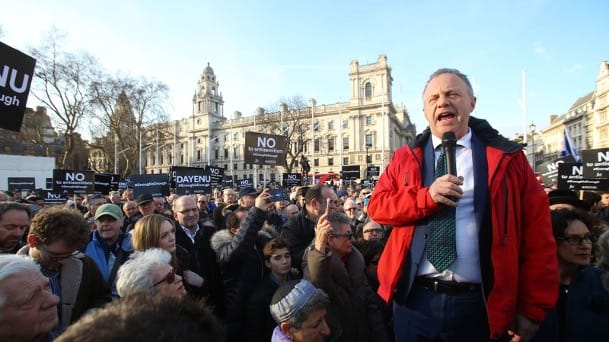
The apparently heroic Jewish struggle against Corbyn that reached its apotheosis in 2018-2019 was thus a product of a preexisting cultural development. In 2018 the Board of Deputies and Jewish Leadership Council organised the Enough is Enough demonstration against antisemitism in Labour, and commentators depicted this as a departure for British Jews, with Jonathan Freedland writing in 2019 that ‘Gone is the quietism of the Anglo-Jewish past, when the communal leadership chose to keep its head down rather than take on, say, Oswald Mosley at Cable Street. Today’s motto is Be Loud.' This view overlooked a long history of British Jewish public demonstrations, such as those in 1962, 1967, 1973, 1980 and the entirety of the Soviet Jews campaign.
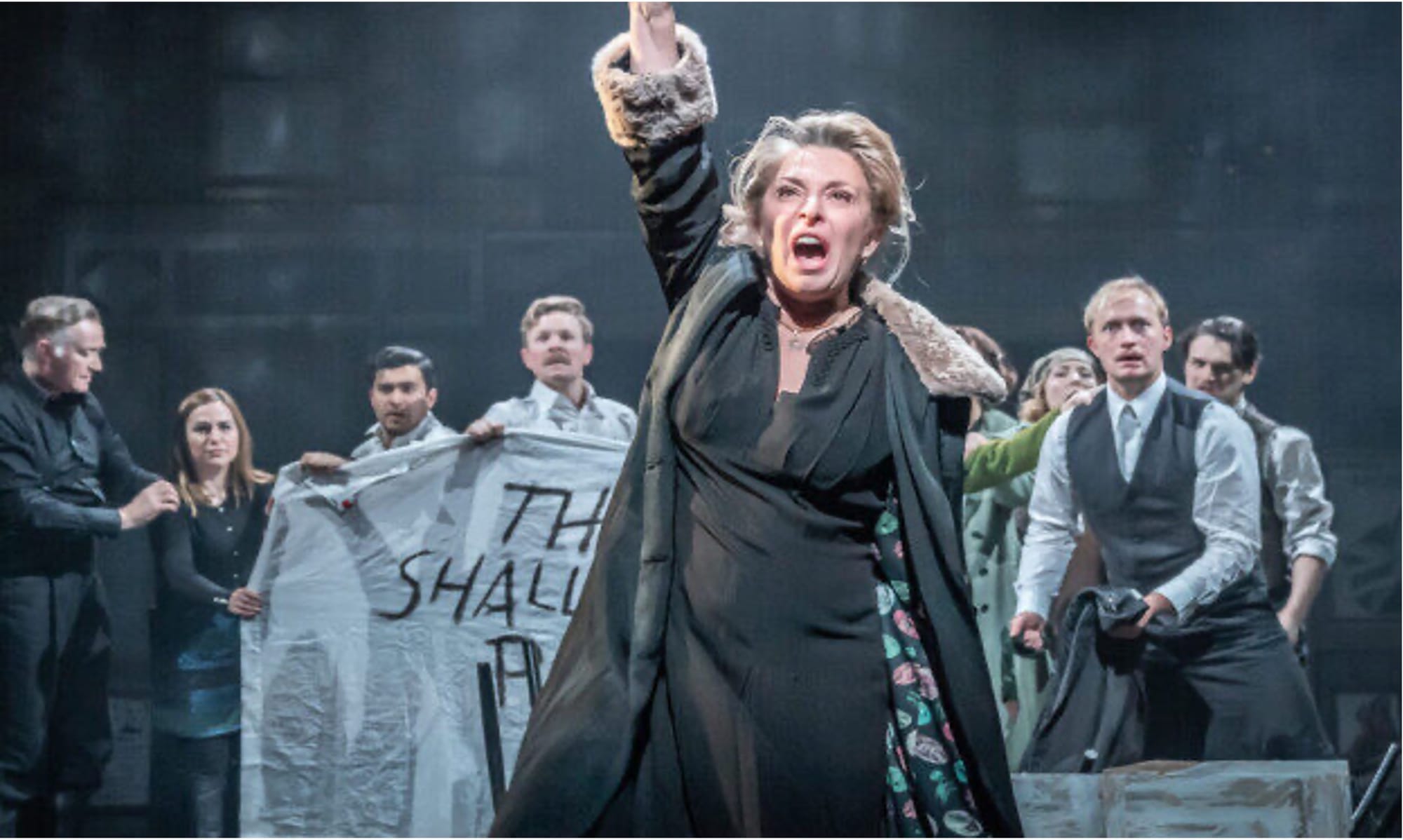
Cultural products of this new atmosphere were Howard Jacobson’s novels The Finkler Question, J and My Name is Shylock centring antisemitism in ways that were new and striking. A similar dynamic was at work in Jo Bloom’s 2014 novel Ridley Road, dramatised by the BBC in 2021, depicting the antics of the 62 group against Colin Jordan’s National Socialist Movement in 1960s swinging London. There was David Baddiel’s Jews Don’t Count, which argued that Britain was an anti-racist paradise for all minorities except Jews and Jonathan Freedland’s verbatim piece Jews in Their Own Words at the Royal Court Theatre in 2022, although only certain types of Jews got the chance to speak in their own words. Then Tracey Ann Oberman’s The Merchant of Venice 1936 opened in early 2023, a shortened and rewritten version of Shakespeare’s play in East End of London in 1936 amidst the rise of the British Union of Fascists. The context for all of these was the perceived rise of antisemitism, particularly the fight against Corbyn, and here Cable Street proved a useful resource to draw upon.
Of course, the new approach was exacerbated by the events that began in October 2023. The notion of a global surge in antisemitism long predated October 7 but gained new popularity as a counter-narrative to the notion that Israel was perpetrating genocide in Gaza. The implication was that there was only room for one of these narratives as the primary summary of the situation; either there was a global war on Jews, of which October 7 was the opening salvo, or Israel was committing genocide and people were angry about it, sometimes unfairly taking out that anger on diaspora Jews. The focus on antisemitism worldwide gained new importance as a way to shape the narrative in such a way that Jews remained in their traditional role of victims, rather than an uncomfortable novelty that presented them as perpetrators. Cultural works inspired by the events of 2018-2019 became viewed through this new prism – even Baddiel who had previously refused to define as a Zionist was willingly co-opted for the pro-Israel cause post October 7.
The fourth and final factor is the increasing openness of the Jewish mainstream to working with groups connected to the far-right. The far-right’s attempt to win Jewish support in the UK goes back at least to the founding of the EDL in 2009. But despite the efforts of a few pro-EDL Jews in the 2010s, Tommy Robinson and his associates were largely shunned. The We Believe in Israel network founded in 2011, proved a means for right wing Christians to work with pro-Israel Jews. There were examples of co-operation in 2018-2019, such as right-wing Conservatives like Norman Tebbit (of the 'Cricket Test') fame attending the Enough is Enough demo, but it has really flourished in the post October 7th climate. New groups that are only tangentially Jewish such as Stop the Hate, and Our Fight have sprung up, groups that are motivated by Islamophobia and focus on Muslim immigration as the primary source of antisemitism. Then in late 2025, repeated and credible reports emerged of Nigel Farage having been a committed fascist at secondary school, and repeatedly bullied Jewish pupils in antisemitic, even Nazi terms. Despite such reports, mainstream Jewish group continued to work with Reform and Nigel Farage, and in early 2026 the Reform Jewish Alliance was launched at the Central Synagogue. One of the leaders of the Alliance, Alan Mendoza, is married to the chief executive of the Jewish Leadership Council Claudia Mendoza, creating a strong informal link between Reform UK and the Jewish mainstream. Then, in May 2026, Reform Deputy leader Richard Tice was controversially invited to speak at a rally against antisemitism organised by the Board and Jewish Leadership Council. A month later, Edgware United Synagogue hosted an Israeli real estate event, in which West Bank properties were on sale. Pro-Palestine activists, including many Jewish ones protested the event, and right-wing supporters of Israel counter protested. The latter called the encounter the Battle of Edgware, framing themselves as the heirs to the Cable Street protestors and the pro-Palestine campaigners as the fascists, apparently invading a Jewish area, despite the fact that it was the counter-protestors who had ties to the far-right.
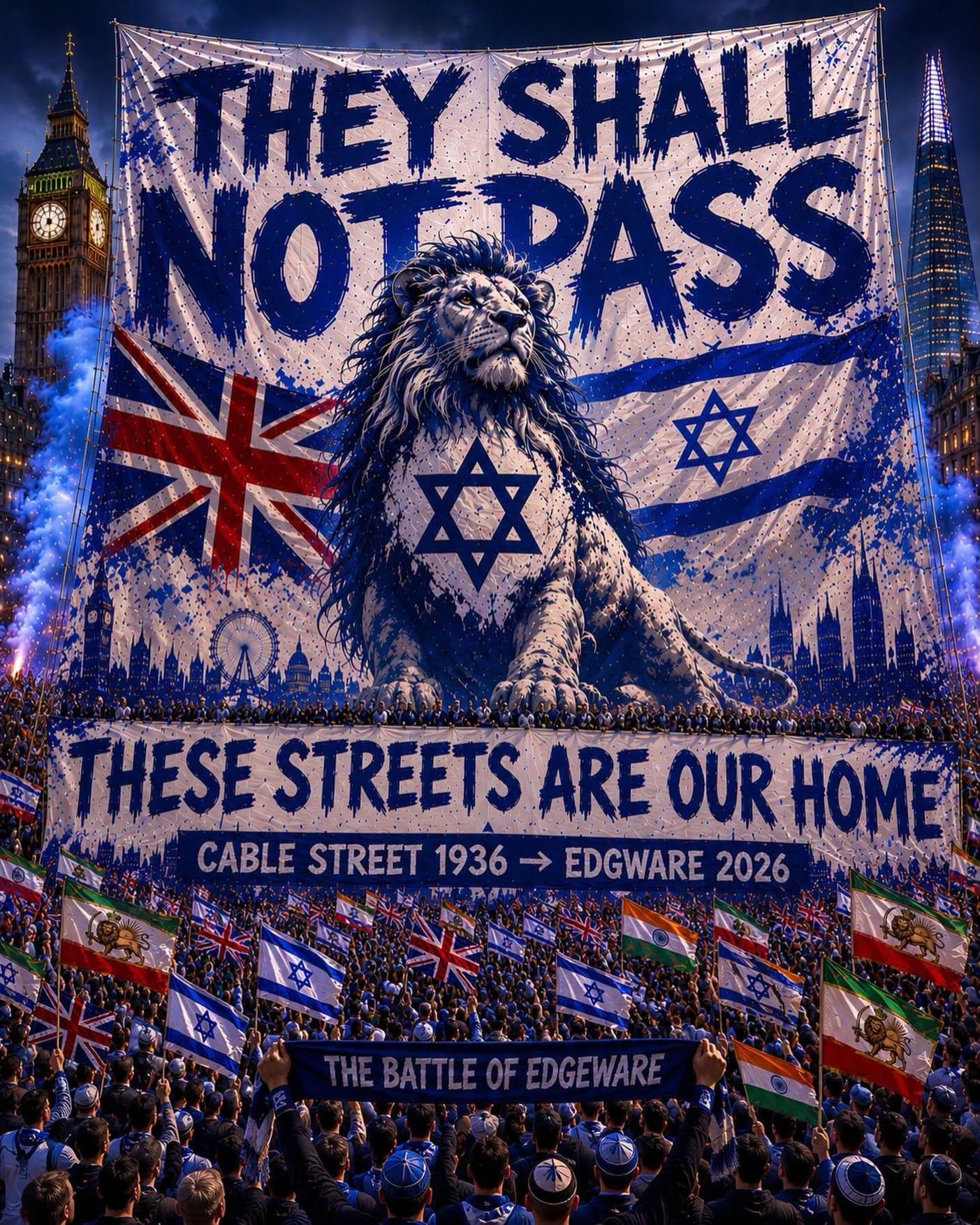
We have reached the point where representatives of what would historically been called the far-right are sought as allies against antisemitism and invited into Jewish spaces and gatherings. The physical descendants of the Cable Street protestors are welcoming the political descendants of the British Union of Fascists.
In this context we had the Board of Deputies cultural festival, which includes an event on Jewish volunteers in the Spanish Civil War by AJEX’s Martin Sugarman whose past writing on the subject emphasises their Jewishness and Zionism, and plays down their Communism; a new film by David Herman called Jews Defending Jews, depicting what it calls the history of resistance to antisemitism in Britain rather than resistance to fascism, produced in association with the CST; a discussion based on Tracey Ann Oberman’s Merchant with her, Howard Jacobson and Trevor Phillips both of whom have made highly questionable comments on race in the past; and a panel on ‘What does Cable Street Mean to British Jews Today?’ featuring Board President Phil Rosenberg, Jewish News journalist Brigit Grant and a representative from the CST. Presumably no representatives of the Jewish left, or the wider anti-fascist movement, were available.
In parallel, the far-right groups sought to attend the major Cable Street memorial march, under their own provocative banners. Much of the rhetoric today is that the left is erasing Jews from the history of the Cable Street but in reality it is non-socialist Jews inserting themselves into it and seeking to claim exclusive ownership.
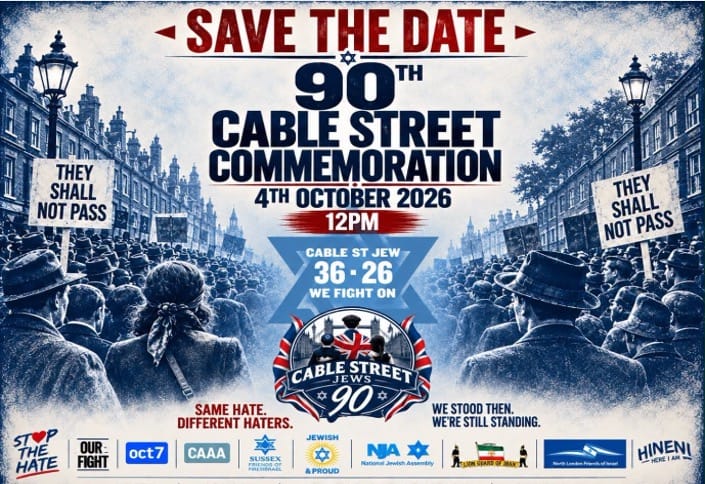
What I think is at work here is an attempt to reframe the historic battle against fascism as a battle against antisemitism. Antisemitism, removed from its historic specificities can be used to describe any movement opposed by legacy Jewish organisations. Cable Street is reimagined as something Jews did against their enemies – the role of the left, and of other ethnic groups has been removed. And as fascism disappears from the lexicon of memorialisation, political forces that continue the fascist tradition can be welcomed into the Jewish tent. In the 1980s we saw the start of a discourse that claimed that the far right and the far left were equal sources of antisemitism; in the 2020s it has become only the far left, in its Israel-critical form that is presented as a danger. The pro-Palestine left, including the many Jews within it, is being treated as the only inheritor of the fascist threat. Communism is omitted from the Cable Street story because it doesn’t fit with the contemporary politics of anti-antisemitism, while the far-right is treated as a welcome source of allyship. All this is a serious distortion of how Jewish anti-fascists saw things, not just at Cable Steet but during the war, in the postwar 43 Group, and even in the 62 Group. The threat then was not loosely defined ‘antisemitism’ but something concrete: fascists, the Blackshirts, the Nazis, Mosley. The changes in the last few years that made possible the Board of Deputies’ Cable Street festival represent a serious historical inversion of the events of 1936. It is difficult to know what ‘They Shall Not Pass’ now means, when the original we, Jewish socialists, are pushed out of mainstream Jewish communities while the original ‘they’ have well and truly passed into Jewish communal life.