Deny Idolatry: Fulfil the Torah
Why the core theology of Judaism is not to love God but to refuse to worship idols, religious or political.

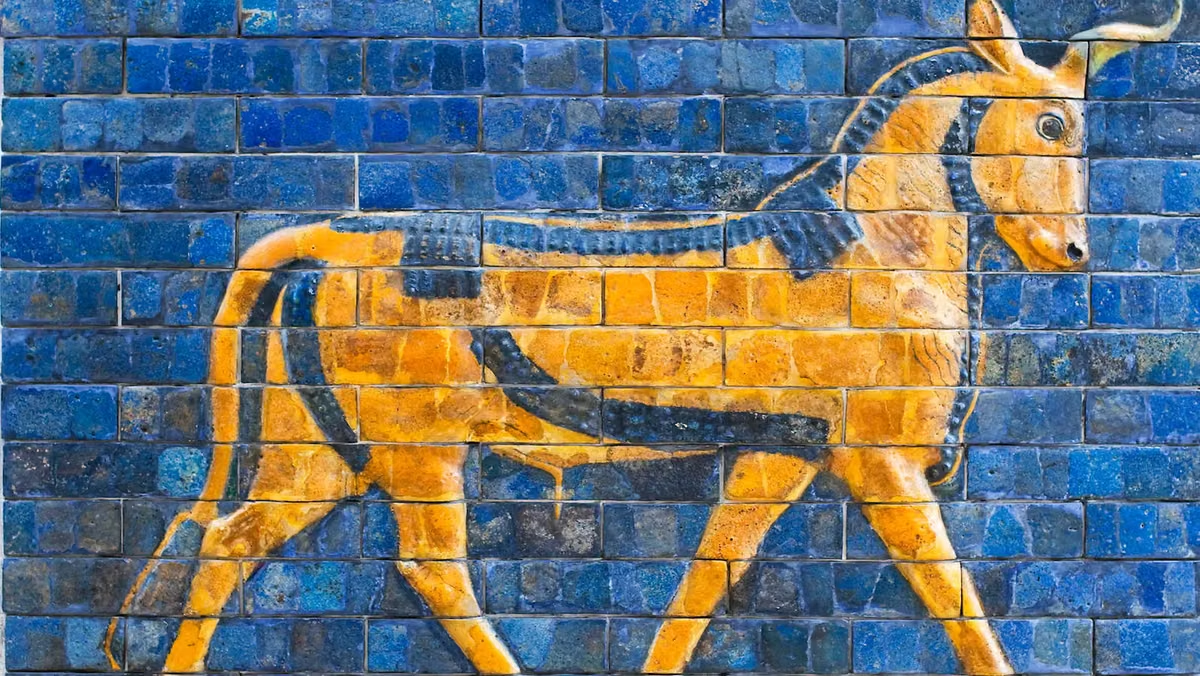
You must destroy all the sites at which the nations you are to dispossess worshiped their gods, whether on lofty mountains and on hills or under any luxuriant tree. Tear down their altars, smash their pillars, put their sacred posts to the fire, and cut down the images of their gods, obliterating their name from that site. Do not worship the ETERNAL your God in like manner, but look only to the site that the ETERNAL your God will choose amidst all your tribes as God’s habitation, to establish the divine name there.
How should we understand this passage in Parashat Re'eh? And how should we think about the prohibition on idol worship more generally? I suggest we start by thinking about the Book of Deuteronomy. The scholarly consensus is that it was written in the 7th century BCE, probably around 622. The 2nd Book of Kings recounts that in the 18th year of King Josiah’s rule, the High Priest, Hilkiah finds a book in the Temple and publicly reads from it. Scholars today believe that rather than finding a book, King Josiah and his scribes in fact wrote one, and that it is something like Sefer Devarim, the book of Deuteronomy that we know today. The priorities of the book are remarkably similar to what Kings II tells us were Josiah’s priorities; centralised worship at the Temple in Jerusalem and the destruction of any other temples elsewhere, such as those to the popular local deities Ba’al and Asherah; pulling down altars, smashing sacred stones, alongside the silencing of mediums and others who claimed to channel the divine.
Now of course, Josiah and his scribes have to pretend that the book is far older than this; that it is prophesying the future rather than simply reporting the present. They have various strategies for doing this – one of which is never to specify Jerusalem or the temple as the place for the only permitted form of worship – but rather hint at it, with phrases like ‘the place which the Lord your God will show you’. The listener is led to a conclusion without it ever being quite spelled out. It will not be like today where everyone worships wherever they like, says our parashah, apparently locating that libertarianism in the era of the wilderness. In fact it was in the land itself that people were doing thus, hence why the writers of Deuteronomy felt the need to polemicise against it.
With this understanding we can see that the commandment to destroy idols was not issued at the point of entering the land, but rather when the Israelites had long dwelled there. In fact, scholars don’t believe there ever was an Israelite entry into the land – Israelites emerged in the land of ancient Canaan, as one of the many groups there, primary the hill dwellers. As the scholar Rachel Havrelock argues, in her book The Joshua Generation, the supposed Israelite conquest of the land was actually a long drawn-out process of attempting to unite various local tribes into a single Israelite nation. Lots of those tribes practiced rituals which would later become seen as idolatry – monotheism only emerged gradually. We can even see this in our liturgy – Mi Khamokha Ba’eilim Adonai, who is like you among the Gods Adonai. This text implies that Adonai is not the only God, but rather the best one in the pantheon. So the commandment to wipe out idolatry was directed internally – not at foreign foes but at other Israelites who hadn’t got on board with the new programme – that there is just one God, who can only be worshipped in one way, in one place.
What then, really is idolatry? I would suggest it is any attempt to say that divinity can take material form. God is transcendent, separate, other, unreachable. We can offer prayers, but since the verb l’hitpallel is a reflexive one, we can never be sure that we are not talking to ourselves. There was once a time of revelation – where Moses at least encountered the divine. But those days are long gone. The only access to divinity now we have is the result of that revelation, through the Torah, a text which is deliberately and divinely unclear, and thus subject to contested interpretation. Vowels and punctuation – the things that would give a Sefer Torah a fixed meaning – would also render it unkosher. Because the words of the Torah are the only thing Judaism recognises at Godly in this world, we are careful never to pin down exactly what they mean. But the idea of God taking physical form, so central to Christianity, is one Judaism cannot accept; from a Torah perspective it’s idolatry, a forbidden mixing of realms.
There’s an objection to what I’ve just said which some of you may already have thought of. What about the Temple? Wasn’t that, according to Deuteronomy, the one place that sacrifices to YHVH could occur, and perhaps even the place that God dwelled . Giles Fraser makes an interesting argument based on this in his theological memoir Chosen, a book about which I hope to write more in future. Fraser had a secular Jewish father, and is married to an Israeli-Jewish woman, and is keen to present himself, and his children, as in some sense true to both Judaism and Christianity. I am sceptical that this is genuinely possible. In the book, he argues that in the 1st century CE, the time of Jesus and the Gospels, the mainstream Jewish theology was that God was immanent in the Temple of Jerusalem, that Jerusalem was seen as the place where the distance between heaven and earth was at its thinnest. He presents the Temple as a form of incarnation – God’s presence on earth. He then suggests that it was not such a leap to claim that a person – Jesus – could also be incarnate, that Temple theology was transferred onto Jesus of Nazareth by the nascent Christian movement. I largely buy what Fraser says about the Temple, I think many Jews did see it like that, and, as Daniel Boyarin has argued, the Gospels are the most representative text of 1st century CE Judaism. But things didn’t end there.
Christianity has a tendency to view Judaism as being the same as it was in the 1st century, as if it was preserved in aspic at the time of Jesus. But we know differently: the Temple was destroyed in 70CE, the Romans banned Jews from Jerusalem in 132BCE and the Rabbis created a new theology that defined the Judaism that we still practice today. They argued that the destruction of the Temple was permanent, that it meant Jews were living in a new era, and that, whisper it, this might not be such a bad thing. The power of the priesthood was over, and the worship of YHVH was no more to be carried out through sacrifices. Instead there would be prayer, three Amidot a day: Shakharit, Minkha and Ma’ariv, with an extra one, on Shabbat and Khagim, modelled on the sacrifices in the Temple. Cohanim and Levi’im would get token recognition – the first aliyot to the Torah, blessing the congregation a few times a year, but these were but shadows of their former power. In the new reality, said the rabbis, the shekhinah no longer had an earthly dwelling, she had gone into exile with the Israelites. The only place she could be accessed, they said, was in the four walls of the halakha. In other words, there was no way to access God outside engaging in halakhic observance, by keeping the ritual and ethical commandments that the Rabbis laid out in their new and revolutionary reading of the tradition. Yes, the prophets had mentioned that one day a redeemer would come, a mashiakh who would fix all problems. But the rabbis made this all but impossible; in practice the messianic claims of such figures were always disputed. Not only because the promised age of peace and abundance had transparently not arrived, but because any messiah is by definition a false messiah. It would blur the divine and the material, and that, for the Rabbis at least, was the cardinal sin.
In his book, You Shall Be as Gods, one of the best books on Judaism that hardly anyone has read, the German-Jewish psychologist and psychoanalyst Erich Fromm continued this theology, arguing that the central commandment of the Bible is not to understand or to love God, but rather to avoid idolatry. He references the Talmud in doing so, Hullin 5a, ‘Whoever denies idolatry it is as if he fulfilled the entire Torah'. Fromm has an expansive definition of idols. He writes: ‘Once idols were animals, trees, stars, figures of men and women. Today they are called honour, flag, state, mother, family, fame, production, consumption and many other names... Is there really as much difference as we think between the Aztec human sacrifices to their gods and the modern human sacrifices in war to the idols of nationalism and the sovereign state?’ He goes on to say that Jewish tradition has ‘raised the prohibition of idolatry to a place as high as, or maybe higher than, the worship of God. It has made very clear in this tradition that God can be worshipped only if and when every trace of idolatry, submission and alienation has disappeared.’
Fromm defines idolatry as alienation and the worship of God as freedom. He argues that in worshipping an idol, humans worship themselves. But only a partial, limited version of themselves, their physical strength, power or fame. The idol is a thing, Fromm says, and it is not alive. ‘God, on the contrary is a living God. The idol is lifeless: God is living. The contradiction between idolatry and the recognition of God is, in the last analysis, that between the love of death and the love of life.’
Defined in these terms, it’s easy to see that idolatry is everywhere. It can be hardest to spot when it is described in Godly times – when the ritual and language are apparently of God, but the action is idolatrous. For Christians this can be a matter of deifying the material, through the figure of Jesus, perhaps the (common) belief the Jesus is on the side of the believer, helping them to gain worldly success. For Jews it can come with ideas that the Jewish people, or the state of Israel are in themselves holy, and identification with them a substitute for an meaningful religious life.
In a recent article, Avrum Burg, former Knesset speaker, writes about what he terms ‘Neo Judaism’, which he portrays as a new religion emerging in Israel, though I think it is occurring in parts of the diaspora too. Burg says that in neo Judaism ‘the Jewish symbol, national sentiments and moral authority are measured by loyalty to the tribe rather than obedience to commandment. It is a religion whose inner life is still unclear yet which is extremely externalized. Long tzitzit, a fashionable kippah, a faith sticker on the car, a gold chain from which something vaguely religious hangs, a rifle slung close whenever possible, tefillin laid in the middle of a city street, and a built in sense of Jewish supremacy. None of them feels any need to apologize.’
He contrasts this with traditional Judaism, which, he says, ‘always cast doubt on the righteousness of the strong and the violent. Today no one any longer sets a religious moral boundary before the powerful, because the Neo Jews are themselves the rulers. They do not serve the army, the army serves them. They have a government, and masses who are ignorant and incited, thus everything is permitted to them. In the old Judaism prophets stood up to speak against the power of a regime and to remind it that power is not the source of justice. But who today needs prophets, when we have ministers of TikTok and fools of gematria.’
The Bible, Burg says, ‘refused to grant Israel automatic innocence. It records without mercy corrupt kings, priests who betrayed their office, false prophets and a public that preferred hollow ritual to full justice. It describes the sins of our own people so as to prevent them from believing that belonging grants automatic purity. The new Israeli religion erases all of this. It turns the Jew into someone innocent by the very fact of being Jewish, and the Palestinian into someone guilty by the very fact of existing. It produces a moral world in which the identity of the one who acts matters more than the act itself. Violence by Jews becomes sanctification of God’s name, and Palestinian resistance is always terror. In this way a false sense of justice is manufactured while a reality of real wrong is created... In place of a tradition that reminds us of the limits placed on the human being, a faith has risen here that tells the Jew that limits are meant for others.’
Here Burg takes us explicitly to our theme ‘And when the state becomes more sacred than the human being, and the land more precious than life, this is no longer faith in God but national idolatry. The name of God still passes through their lips, but the true object of worship is Jewish power.’
‘I am not interested in how many people pray’, he says. ‘I do not count how many commandments they keep or how many verses they can recite. What I look for in them, and do not find, are other answers: have they grown more sensitive to suffering, more careful with their power, more responsible for their actions. The answer, as of now, is terrible. Their Israel is the largest organised idolatry in the history of Jewish faith. Therefore the commandment placed on me as a Jew is to smash their altars.’
It’s never easy to combat idolatry. By definition, the things we idolise are things we like, are things that are very close to us, things that give us a feeling of connection. But it is always a mistake to confuse the finite and the infinite, a part for the whole, the God of the universe for the God of a particular people or place. To take a stand against idolatry today might feel like standing against much of the Jewish people, but it is in fact in line with the deepest meaning of the Torah. The answer is not to tear down the idols of others. It is, as it always was, to deny the idolatry that we find in ourselves.