Ed Miliband: the Red Rebbe and Master of Teshuva
In sanctioning Israeli settlements Ed Miliband has shown himself to be far more Jewish than his critics

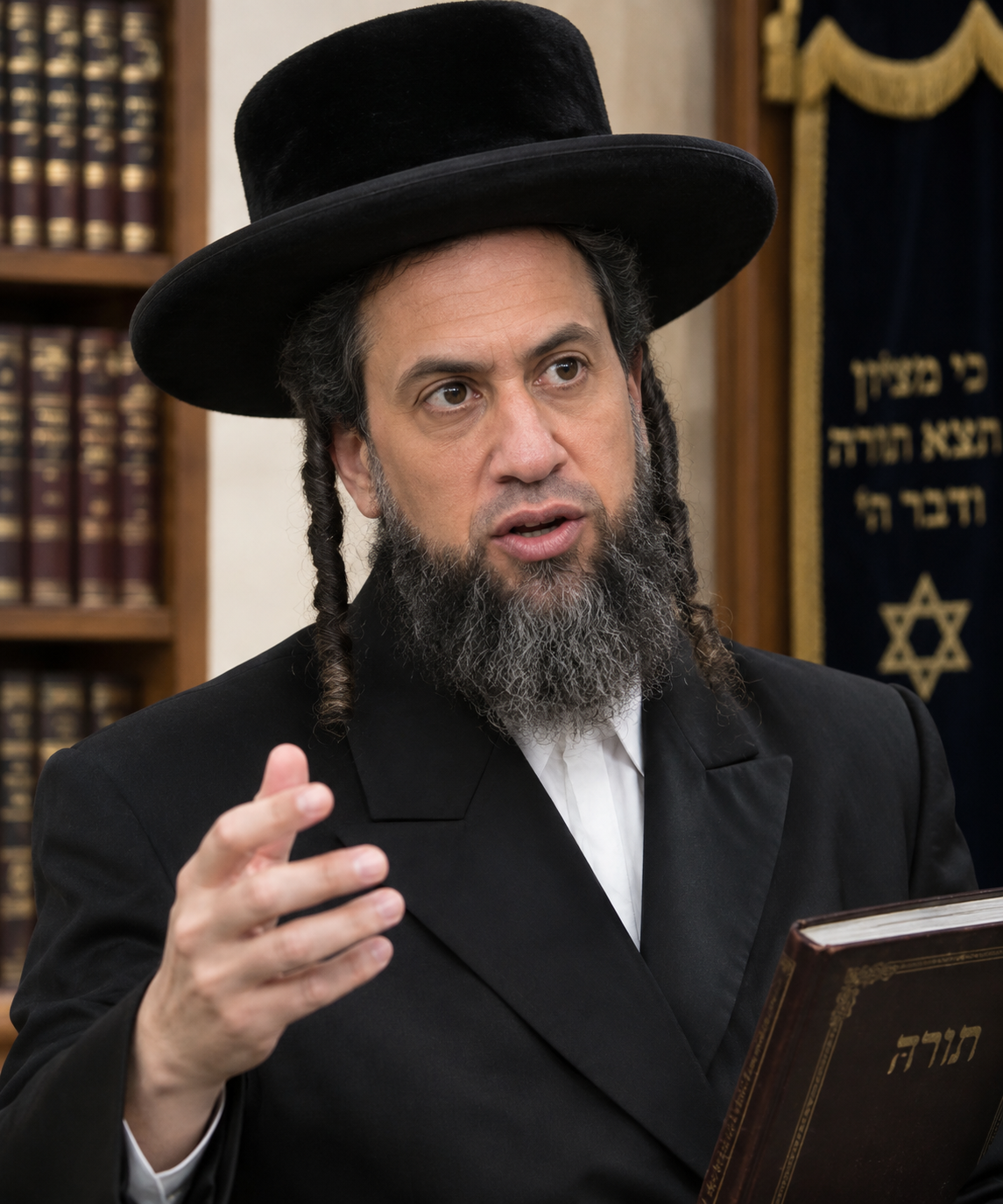
The month of Elul is a period of introspection, in preparation for the holy month of Tishri, filled with the great festivals of Rosheshone, Yom Kipper, Sukkes and Simkhes Toyreh. In Elul, many chasidim would visit the Rebbe, seeking wisdom and blessings. In the UK a few weeks ago there was a pilgrimage that was in some ways similar and in some ways quite different. A chorus of British Jewish leaders queued up to hold meetings with Ed Miliband, recently appointed Foreign Secretary in Andy Burnham’s government. The meetings were held because it was widely known that the government was planning to announce sanctions on Israeli settlements in the West Bank, and the cavalcade of leaders (the Chief Rabbi, Progressive Judaism CEO’s Josh Levy and Charley Baginsky, Phil Rosenberg and the Board of Deputies, and Yachad’s Hannah Weisfeld). In all the pictures Miliband looked, understandably, less than delighted to be there. The communal figures were there to urge the foreign secretary not to do it, to do it, or to do it a bit less and preferably not right now. A disinterested observer might ask what business UK Rabbis had discussing policy towards Israel, seeing as we are not supposed to conflate British Jews with Israel. But insiders know that this conflation is done more by Jewish communal leaders than any non-Jewish ones. The supposed justification for their presence is that policy towards Israel may affect the lives of British Jews, but nobody is fooled. They are there to try and move the government’s policy towards Israel-Palestine in the direction they want it to go, as British Jewish leaders have done since the Balfour declaration, just over a hundred years ago.
The interesting point is that Ed Miliband is Jewish. He was from 2010 to 2015, the first Jewish leader of the opposition in Britain and received some pretty explicit antisemitism via the infamous bacon sandwich picture and the Daily Mail attack piece on his father as being a communist subversive ‘who hated Britain’. As a matter of fact, being a communist and hating Britain are praiseworthy. So nu, the Jewish communal leaders are going to meet with a fellow Jew. That surely changes the nature of the conversation somewhat. But the unfortunate, or perhaps the delicious thing, is that Miliband is just the kind of Jew that the Chief Rabbi, and the Board of Deputies hate. They only grudgingly recognise him as a Jew at all. If he was not in a position of power they would not be meeting with him. Their communal predecessors loathed him when he was Labour leader. Not because he is secular. But because he is left-wing – his father was indeed a Marxist intellectual, his mother a socialist also, and a founding signatory of Jews for Justice for Palestinians and Independent Jewish Voices to boot. It was less like visiting the Rebbe and more like visiting the Rabbi of the shul you’d never be seen dead in.
Ed Miliband identifies as a secular Jew. But he is repeatedly and proudly Jewish, something that not long ago was a rarity for a British politician. In his first conference speech in 2010 he discussed his parents’ story as Holocaust survivors and refugees to Britain: ‘My love for this country comes from this story. Two young people fled the darkness that had engulfed the Jews across Europe and in Britain they found the light of liberty’. His 2012 conference speech drew heavily on Benjamin Disraeli, surely an attempt to link himself to Britain’s only Jewish (by birth) Prime Minister in the public mind. In 2013 and 2014 he was equivocal on the question of whether he identified as a Zionist, saying instead that he saw Israel as ‘a homeland for the Jewish people’ (‘a’ homeland, rather than ‘the’ homeland, and not necessarily a state). This was surely because, unlike non-Jewish politicians who were happy to say whatever their Jewish or Israeli audience wanted to hear, Ed had some idea what Zionism actually meant and didn’t wish to associate with it. Why would he identify as a supporter of an ideology which believed all Jews should come to Israel when he was at home in Britain and in the international class struggle? Incidents like this made him incredibly unpopular with communal grandees. The ‘Labour has abandoned the Jewish community’ narrative began not with Jeremy Corbyn but during Miliband’s leadership in 2014 after he criticised the Gaza war of that year and whipped Labour MPs to vote for recognition of Palestinian statehood.
In his landmark announcement Miliband held true to both his critical approach to Israel, and to his pride in his Jewish identity. As he announced unprecedented sanctions on settlements and on those who fund them, and an acceptance of the ICJ’s 2024 advisory ruling that the entire occupation of the West Bank, Gaza and East Jerusalem is illegal, Miliband simultaneously articulated how proud he was of his Jewishness. He was doing this, it was apparent, not in spite of his Jewishness, but because of it. His detractors claimed (often in borderline racist terms) that it was all partisan politics, an attempt to win back leftwing and Muslim voters who had defected to the Greens. But Miliband was very clear; he declared repeatedly that he was doing it because it was the right thing to do. That if one recognised the suffering of the Palestinian people, that if one thought the occupation was illegal under international law then one had an obligation to do something about it. There was a degree of slippage between Britain’s obligation and his personal obligation; clearly the former was only being activated by the latter. Britain had to act, yes because it had done too little over the past few years (its far greater sin of cutting and running without leaving any plan in place in 1948 went unmentioned), but also Jews had an obligation to act, and there was no doubt that Miliband was speaking as one. He was Britain’s first Jewish foreign secretary and he was going to make the most of that unique situation. Miliband’s language was full of the language of obligation; necessity, demand, moral requirement, must. He wasn’t far off using the language of Judaism: of mitzvah (commandment), of khayav (religious obligation), of teshuva (repentance), even of hineni (here I am), the prophetic acceptance of the task.
In the wake of the announcement Miliband’s Jewishness was questioned in highly offensive ways. In an interview on the Today programme, the (non-Jewish) presenter Justin Webb asked Miliband if he would be attending synagogue for Rosh Hashanah. It seems unlikely that Webb would ask a Christian guest if they would be attending church for Easter or a Muslim guest if they would be fasting for Ramadan. Where is David Baddiel when you need him? In another political universe the Board of Deputies would have called this antisemitism. When Miliband replied that no, he didn’t go to synagogue, Webb answered: ‘Isn't that then the point? That actually for a lot of British Jews, they really feel this. They have to have security duties at synagogues. They know that there have been violent attacks. And that is why when Ephraim Mirvis uses those words. They mean an awful lot to them and perhaps frankly, less to you.’ Webb was explicitly saying that Miliband was not a proper Jew and was not entitled to claim Jewishness because of his lack of synagogue attendance. Never mind that JPR found that 43% of British Jews do not attend synagogue on Rosh Hashanah. Real Jews, according to Webb, fear attack and have to be protected by security. If you are not afraid, and do not feel in need of protection, are you even Jewish? The rhetoric of Mirvis and other communal Jeremiahs has empowered non-Jews like Webb, to un-Jew Miliband. They are not doing so because he does not attend synagogue. Are they similarly checking the shul-going records of Howard Jacobson, Simon Schama, Melanie Phillips or Tracy-Ann Oberman? No, because being pro-Israel gives you a free pass to be as secular as you like. They are doing this to Miliband because he is leftwing and he is sanctioning Israel. In the brave new world of mainstream contemporary Judaism there is only one commandment: Love the state of Israel with all your heart, with all your soul and all your might, and do nothing to criticise it.
The irony is that in a deeper sense Ed Miliband is far more Jewish than his critics. They said his announcement was poorly timed, coming just before the High Holydays when British Jews would be in synagogue and fearing an attack like last Yom Kippur’s in Manchester, and because of the upcoming Israeli elections. In fact, Miliband’s timing was impeccable. The Yomim Noraim are not just some Jewish ethnic shmooze club where Jews get together to eat, feel proud of Jewish celebrities, wave the Israeli flag and fear attack. They have actual religious content: they mark a process in which we examine our conduct, and engage in teshuvah (repentance), tefilah (prayer), and tzedakah (charity but better understood as justice) in order to become better people. We seek to be written in the Seifer Khayyim, the book of life, for the year to come. Famously the (many) prayers listing our sins are written in the 1st person plural; we have been culpable, we have been treacherous, we have robbed, we have slandered etc. That is because the process is not purely an individual one but collective; we repent for the things we have done as B’nei Israel, as a people. While the sins committed in Gaza and the West Bank in the name of the Jewish people may not be in the liturgy of mainstream synagogues this year, they will be mentioned in the growing number of non/anti-Zionist or diasporist Jewish synagogues emerging across the world. Ephraim Mirvis will doubtless spend a lot of hours in prayer during the Hebrew month of Tishri. But if he does not consider Israel’s killing of thousands of Palestinians, and the many examples of Hilul Hashem carried out by settlers and only focuses on what has been done to Jews, then he will be doing the Yomim Noraim wrong. Ed Miliband, in contrast, gets it. For him to deliver his statement during the season of teshuva, following the traditional pattern of admitting wrong and resolving to do better in future, was perfectly timed.
Of course, Ed Miliband defines as a secular Jew. His Jewishness is rooted in his family story, of his parents both fleeing Nazi Europe, and an acute awareness of the dangers of fascism. For Miliband, it is that history which commands, rather than God or Torah. That and the legacy of his mother, with her commitment to Palestine, which is pretty damn Jewish as a motivation. But the idea of secular Jews carrying out a religious task, intentionally or not, is hardly a new one. Rav Kook famously proclaimed that secular Zionists were carrying out a divine role by settling the land of Israel. And Rabbis of all stripes could not help but see the 1967 war in miraculous, messianic terms, despite that IDF being at that point a wholly secular institution. The idea that unbelieving Jews are doing God’s work through Zionism is commonplace, including within Orthodoxy which might have been assumed to be immune to such thinking. What is new is the idea that secular anti-Zionist, or simply Israel-critical Jews, might also be doing necessary and holy work. But given the strong tendency in Jewish tradition to look inward, to blame our suffering on our own conduct, rather than blame others, it is a view much more in line with the mesorah than Rav Kook’s chalutzim.
It would be (too) easy to simply condemn the communal responses to the government’s move. And there is much to condemn, when they are rooted in nationalism rather than any traditional Jewish approach. But better, and more constructive, to celebrate Ed Miliband for doing the right thing, and proudly doing so as a Jewish politician. We are used to think only of Jews exercising power as Jews in Israel, while being disempowered individuals in diaspora. Jewish politicians holding power under the auspices of Western States – from Edwin Montagu to Herbert Samuel to Leon Blum to Bruno Kreisky – complicates that binary. We now have a new generation of such leaders, like Claudia Sheinbaum the Mexican President, Avi Lewis the leaders of Canada’s NDP and of course Green Party leader Zack Polanski. Alongside such progressive Jewish figures, Ed Miliband is – consciously or not – showing what Jewish moral leadership in this moment looks like. The term Bal Teshuva is usually used for Jews who have become newly religious, but it literally means a master of teshuva, of repentance, and Ed Miliband has shown he is that with bells on. He certainly isn’t the Rebbe that communal grandees want. But he might just be the Rebbe that we need.
Support my writing here https://buymeacoffee.com/toratalbion